


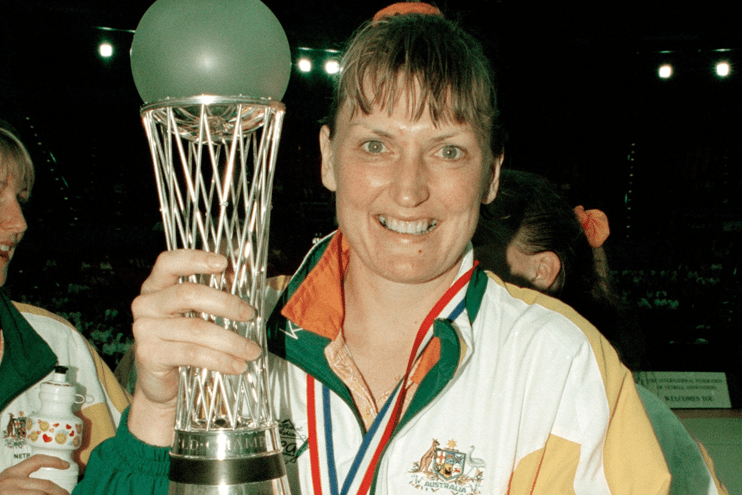
When the Diamonds take on South Africa in Adelaide, it will be a full circle moment for Michelle den Dekker. 30 years after Australia’s most successful netball captain led her side to the 1995 World Cup victory, celebrating that success in her home town feels pretty special.
“The older you get, the more it means,” said den Dekker. “It’s your whole life when you’re younger.
“You give up everything to play sport at that level, of not going to family dinners, to christenings, or weddings. Training morning and night to be the fittest you’ve ever been, and you become quite selfish in your nature as an elite athlete.
“You do everything for yourself and the team to get the wins, and it’s only as you get older, look back and realise the sacrifices that you made, but also the joy that it brought you and how lucky you were to have the opportunity.”
The brilliant goal defence played 84 tests for the Diamonds – her last one in the 1995 Netball World Cup victory – with a remarkable 92% winning record across her 71 games as captain. In a dominant era for Australia, den Dekker finished her career with two World Cup victories (1991 and 1995) and a Commonwealth Games gold (1990) while netball was still an exhibition sport.
Australia’s success during that time, den Dekker believes, was built around a team of exceptional athletes. “We had specialist people in really key positions. Players that did their job brilliantly. Champions out on court that just bring that little bit extra to the game.
“So I’m very grateful to Netball Australia for celebrating the team, because I believe those players shouldn’t be forgotten.”

The 1995 World Cup team reunite at the Adelaide test match. Image: Hannah Howard/On the Ball Media

The 2025 and 1995 Diamonds, plus South Australian legends at training in Adelaide. Image supplied by Netball Australia.
CHANGING TIMES
While it’s just 30 years in the rear vision mirror, den Dekker played in an era when elite female athletes were treated very differently. With limited research around their physiological needs, training programmes replicated those of men, wellbeing and sports psychology weren’t in the dictionary, and team management was based on hierarchical standards.
Society has changed dramatically, and netball has had to adapt to those changes, said den Dekker. “I think we now view our female athletes more as women operating in an elite environment, rather than as one collective.”
Off court player management, for example, was generic, with limited flexibility for the athletes. They usually stayed in student-style accommodation, with one team bus to get them to and from fixtures. Den Dekker said,
“They are now able to stay in apartments, to be able to swim or go out for coffee or do some shopping. Smaller vehicles also mean they have the flexibility to go out in fours and do things.
“It’s more of a home environment where they can feel normal, rather than have people sitting in authority over them all the time. While I loved that style at the time, it’s part of a natural evolution that’s happened along with society.”
Coaches also operated differently. While den Dekker rates her long term national mentor, Joyce Brown, as the most influential person on her career, her word was law.
“I loved Joyce – she was the best coach I ever had – but if she said jump, you jumped.
“She was ahead of her time in the way she loved, respected and treated us as individuals. We used to get huge amounts of written feedback – in those days before statisticians, she used to do it all, and put an enormous amount of work into her coaching.
“She had high expectations and was very, very caring of us all but she was also of an era when times were different and we always did as we were told. If you didn’t, you were ripped off court. There wasn’t the same element of collaboration you see now.”
During her era, strength and conditioning specialists were also in the future, so den Dekker relied on help from her footballer husband. Most of her conditioning involved running, and lots of it. One of the fittest netballers to ever take the court, den Dekker said, “Joyce would tell me off because I did so much. I didn’t have the core strength the girls have now because there wasn’t Pilates, or the weights programmes the girls do. We were all about resistance training.
“We perhaps had the edge in speed and agility, but today’s athlete is much stronger, more powerful and more dynamic. I think the game has changed to accommodate that. Netball has become very much about the lack of errors, and keeping possession of the ball.”
Den Dekker still loves watching athletes who are prepared to have a fly for the ball, something that she said was far more prevalent in her era. Back in the day, her ultimate aim was to get 15 to 20 intercepts – per game! That included three attempts to turn the ball over in the first five minutes of each quarter.
That aspect of the game has changed significantly, and she should know, having written a thesis about it for her High Performance Coaching Accreditation. Den Dekker explained, “I was really process driven to make those intercepts and deflections happen, but you rarely get that number in a game these days from a defender. It’s declined. That is because of the very different game style we now play.
“There was a lot of creativity in how we played, and we very much relied on a risk versus reward style.”

Michelle den Dekker was Australia’s longest serving netball captain. Image supplied by Michelle den Dekker.
MIND SET
Den Dekker appreciates the transparency she sees in the current era, which she believes is important. Gone are the days when selection was largely based on performance at the National Championships, and athletes waited in a room together to hear if they were selected, with those who weren’t exiting left and sent straight to the airport.
She said, “It was really harsh. Luckily I never bore the brunt of non-selection, but players were devastated when they were shipped straight out of there in tears.
“Players now have more opportunities to prove themselves in camps, there’s statistical performance analysis, lots of people looking on. So much depth to selection.
“I was on a panel recently for the Australian captaincy and it was very thorough and very transparent.
“I’m really proud that we’ve moved in those different directions, and are far more process driven with the players.”
What hasn’t changed is an elite athlete’s need to be comfortable with being uncomfortable – a vital tool in den Dekker’s opinion. “You have to learn that as both a player and a coach at that level. To have a calmness, a sense of strategy and be able to process being pushed into uncomfortable places and situations. Being able to live in those moments, to be resilient, is crucial.”
Greater knowledge and support around female athlete’s fertility is one of several reasons why women are now playing netball well into their thirties, rather than stopping elite sport to have a family.
Den Dekker said, “We had no idea whether we were fertile, we just took the chance, whereas these days players can be tested for a range of things to give them some peace of mind.
THE 1995 NETBALL WORLD CUP
Unexpectedly but gloriously twelve weeks pregnant at the start of the 1995 Netball World Cup, den Dekker told only Dr Grace Bryant, the Australian team doctor. “I was a bit frightened about letting anyone know because my concern was that it might affect selection, and I wanted to be out on court on merit.
“Grace really looked after me. She said we don’t know enough about it, so we were taking my rectal temperatures before and after each match to make sure my core temperature wasn’t too high. Oh my god! But I didn’t worry because it was early on, I felt so well, and I had a job to do.”
Vice-captain Vicki Wilson was let into the secret after she spotted quite a change in den Dekker’s bust, with her usual crop top swapped for a sports bra. “I don’t know how the other girls didn’t cotton on, but Vicki did.
“She said, ‘Usually you’ve got nothing there. What’s going on?’ So she put two and two together.
“It was pretty special for me knowing that at the end of it I could let everyone know. We say Jacob was at the World Cup with me, and he’s thirty now and I’m a grandma.”
To den Dekker, the 1995 Netball World Cup wasn’t only memorable for her pregnancy, but for a change in national coach from Brown to Jill McIntosh, Vicki Wilson’s tragic anterior cruciate ligament rupture during the tournament, Jenny Borlase’s ability to step up in her absence, the emergence of the Irene van Dyk led South Africa, and a massive 20 goal win in the final.
“It was devastating for Vicki,” den Dekker said. “She was my vice-captain, but we were also very close. I cared about her as a person and it was devastating for her.”
Sitting behind Wilson, Jenny Borlase had mainly warmed the bench until injury struck the team, but den Dekker had full faith in her ability to step up into the starting seven.
“She was one of my Garville teammates, and I knew her as an amazing shooter, very accurate, and that she was ready. At the time we had crowds of five to six thousand people here in Adelaide, and I think that really paved the way for her having already played in high level and stressful situations. So she came on and didn’t miss a beat. That didn’t worry us, it was more about the loss Vicki was going through.”
To the surprise of most, South Africa met Australia in the final, after beating New Zealand in an earlier round. The final score of 68-48 was reflective of a developing national team coming out of the Apartheid years, versus a team that included powerful defenders, one of Australia’s best ever midcourts, and creative and accurate shooters.
“It’s lovely to win by that much, of course,” said den Dekker, “but for my final match with Australia it was a bit of an anti-climax. There was time on court to enjoy it, but it wasn’t the close match we’d been expecting.”

Defensive coach for the Diamonds, celebrating their 2015 Netball World Cup win. Image courtesy of Michelle den Dekker
END OF AN ERA
While den Dekker continued with domestic netball for a few more years, and then moved into coaching, the 1995 World Cup was the end of her national career. She’d had enough.
“I was 18 when I started, and it was all consuming. As well as those trips to Canberra every weekend, I was travelling for events as a captain, juggling married life and work. I just couldn’t fit it all in.
“So while I still loved my netball, the lifestyle and all that time spent sitting on planes was overwhelming. The travel wears you down, and by the time I was 30 I knew I was done.”
While improved financial rewards entice players to stay in the sport for longer, den Dekker believes more holistic management is their main key to longevity. She explained, “Their training is mapped out over 12 months, with the national and club programmes working in conjunction. There’s a lot of collaboration around what is best for you and your load.
“It’s all tracked. Players log in every morning, and check lists about their sleep, their nutrition, their mood and mental health. It’s a much more rounded approach. Back then, we were asked if we were okay and sort of bluffed our way through it so we’d still be considered for selection.”
While lifting the World Cup trophy is a distant but fond memory, the players remain intrinsically connected. It’s easier to catch up with teammates based in the same state, but they’re all members of a WhatsApp group and catch up when they travel. The memories of each player and their idiosyncrasies, said den Dekker, will last her a life time.
Den Dekker is humble about her achievements with the Diamonds, and particularly as their longest serving captain, believing her success was built on the ‘great’ players around her.
“I really, truly believe that these strong, powerful, dynamic women all led. And that during the tough times, they were all capable of stepping up. That was an important part of our group dynamics and the culture that we’d had. Staying strong together.”
The 1995 Australian Netball World Cup team
Natalie Avellino
Jenny Borlase
Nicole Cusack
Carissa Dalwood
Michelle den Dekker (captain)
Liz Ellis
Kathryn Harby
Simone McKinnis
Marianne Murphy
Shelley O’Donnell
Sarah Sutter
Vicki Wilson (vice-captain)
Coach: Jill McIntosh