

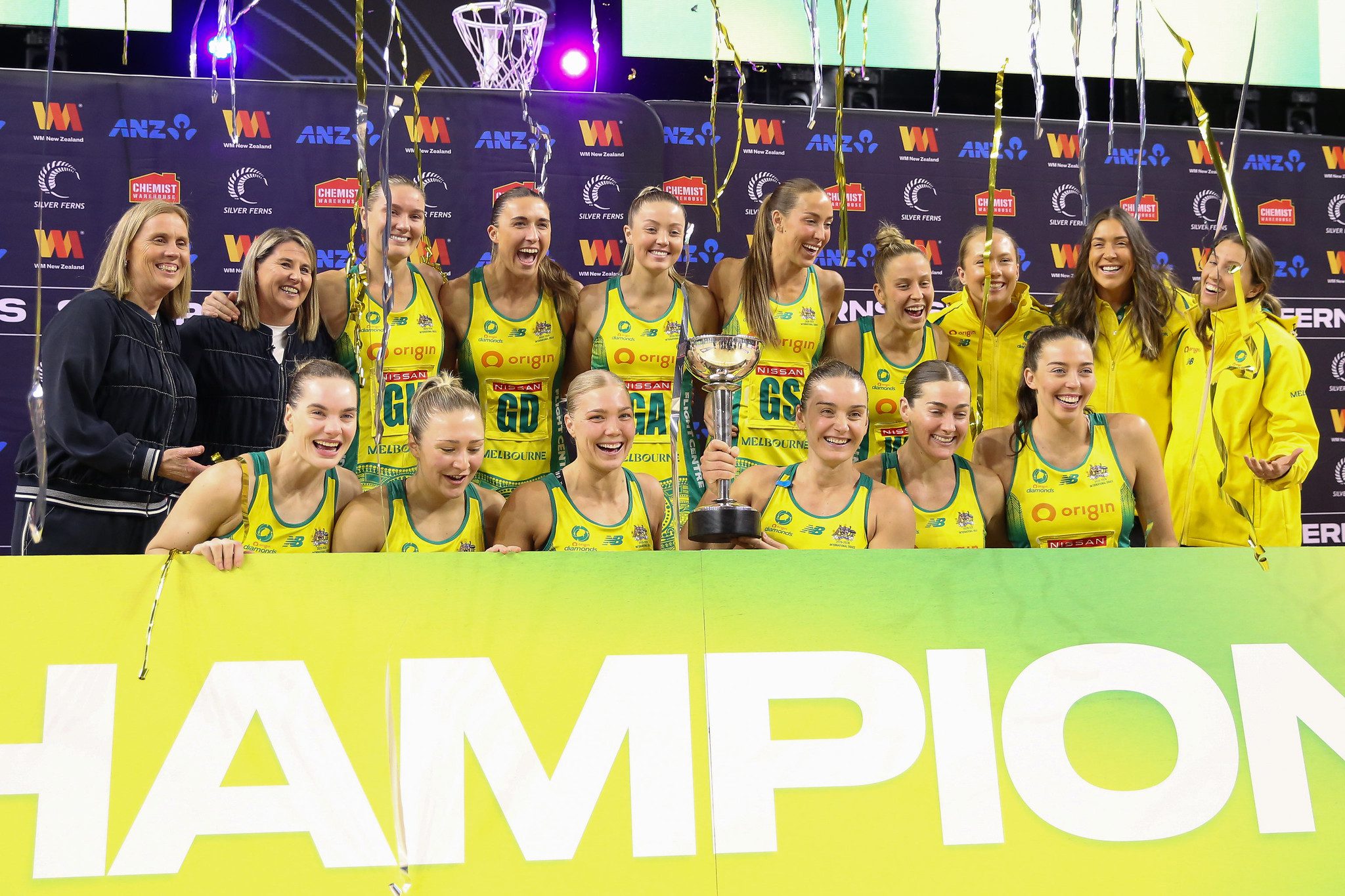
With the Diamonds’ 2025 international campaign done and dusted, it’s time to look ahead at next season and the rapidly looming Commonwealth Games. In the recent test series against South Africa and New Zealand, we got a look at 18 players out on court, with each pushing for a place in the final 12 heading to Glasgow. So who makes the cut, and what are the seven biggest questions that need answering?
1.Cara Koenen has been down on form lately. Will she be on the plane?
In a nutshell, yes, but she’s no longer Australia’s starting seven shooter. That bib now belongs to Sophie Garbin, who always goes up a gear or three when she puts on the gold dress. Garbin’s hold and timing in the circle is exquisite, while she’s also built a formidable combination with first choice goal attack and Melbourne Vixens’ teammate Kiera Austin.
That said, at 184cm, Garbin isn’t the get-out-of-jail-free card that is worth up to an extra 20 goals for sides with a tall and athletic shooter. Both she and Austin, with her low release shot, can be troubled by defenders with long arms or great elevation in the circle. So there’s a need for some height, and the 190cm Koenen best fits the criteria.
Although she’s been plagued with a few ball handling issues recently, in top form Koenen is a mobile and agile shooter that fits right into the Diamonds’ game plan. She can play the baseline like few others, is always available on second phase and rarely picks up the offensive contact penalties that some other shooters do.
Koenen does have some work to do on her shooting technique which left her with accuracy woes and limited court time in recent test matches, but at the moment she’s a better bet than the other talls in the Australian squad. Lucy Austin and Donnell Wallam both lack Koenen’s experience at international tournaments, while Wallam has also had a wretched run with injuries and illnesses at pivotal times, which could be seen as a selection risk.
The biggest wildcard here is Gretel Bueta – she’s never officially retired, and will be back on court next year in Malaysia. While it’s only a short season there, if she went knocking on the Australian selectors’ door, they’d very likely invite her in for a cup of tea and a chat.
2.Is Georgie Horjus selected as a shooter or a midcourter?
Horjus has such an incredible netball IQ, so needs to be in the Diamonds in some capacity. I’d take her as a shooter, with the capacity to slide across to wing attack if needed. Why? It mainly comes down to her height of 172cm, which troubles me a little. Playing wing attack, Horjus has to look over the long arms of her opponent and into the circle, which does restrict her vision somewhat. It also limits her ability to provide defensive pressure in transition.
At goal attack, these issues are less apparent. Instead of spending most of her time trying to sight the shooters, Horjus is instead cutting and driving into the circle, generally leaving her opponents’ heads spinning. Exceptionally long arms over the shot – like Kelly Jackson’s – impacted her accuracy in the Constellation Cup, so Horjus has some work to do on the a-la Steph Fretwell rock back or sideways, while she could also receive greater protection from her goal shooter.
With a cool head on her shoulders and a great connection with Garbin, Kiera Austin has first dibs on the Diamonds’ first goal attack bib. However, the attacking combination of Garbin/Horjus/Teague-Neeld/Watson showed some impressive glimpses against South Africa.
While Sophie Dwyer has served her apprenticeship and can coolly slot straight into a game, she doesn’t quite have the wow factor of Horjus and so could be overlooked for the Commonwealth Games team.

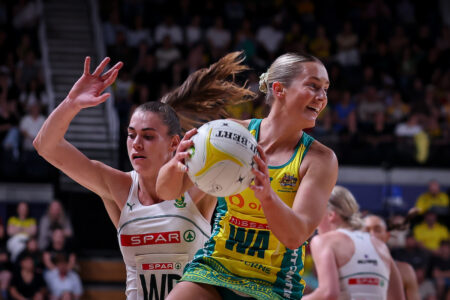
Kelly Jackson piled the pressure on Georgie Horjus. Image: Tash Rudd
3.Is there room for Alice Teague-Neeld?
Absolutely. While captain Liz Watson remains Australia’s key wing attack, other sides know her game inside and out, and work hard to nullify her. So to keep opponents guessing, there needs to be a change-up with a completely different game style rather than just more of the same. Enter Teague-Neeld. She offers something very different from the other Diamonds’ wing attack contender, Hannah Mundy, who currently has similarities to Watson’s strong and direct approach to the circle.
Teague-Neeld has fantastic game smarts, and her timing, feeds and speed on the release contrast beautifully with Watson. Standing at 182cm, she has both the height to look into the circle, and offers a strong defensive game – great hands over pressure which slows down an opposition’s transition into attack, while she reliably comes up with some gains in most matches.
The loss of Sunday Aryang to injury has significantly changed up the Diamonds’ rotations, making a place for Teague-Neeld an even stronger possibility, even if she is a predominantly one position player. See Point 6 for my thoughts on how Australia can adapt to this challenging issue.
However, whether we see a new Diamonds’ midcourter will also come down to Paige Hadley’s availability. Currently on maternity leave, Hadley is unlikely to have enough time and match practice to make the Commonwealth Games team. But having seen Hadley force her way into the team in the past, never rule out her elite fitness levels, safe pair of hands and sheer determination. Her experience is also invaluable, having been to the last five major tournaments since her 2015 Netball World Cup call up.
4.Kate Moloney has only recently cemented her place as the Australian starting centre, with her form rewarding her as the 2025 International Player of the Year. What changed for Moloney?
Ironically, the move of Liz Watson to Sunshine Coast Lightning has been responsible for Moloney’s rise in the Diamonds. At the Vixens, Watson was incredibly dominant feeding the circle, with Moloney spending more time connecting both ends of the court. With Watson’s move and inexperienced wing attacks around Moloney, she had to take on more responsibility for finding her shooters, and did it beautifully.
This has translated straight into the Diamonds’ game plan of working with a mobile, shorter, shooting circle. Australia are far less predictable when they have multiple feeding options, and can work triangles around the circle until their shooters open a good position. And while Moloney doesn’t always have the speed on release when a shooter is free, she is generally a safe pair of hands and rarely gives away a turnover.
Moloney also provides exceptional leadership qualities, and with the group in a transitional phase with some new players entering the mix, her role as vice-captain is invaluable.

Kate Moloney was a well deserved MVP for Test 1. Image: Aliesha Vicars.
5.What is Jamie-Lee Price’s best position?
This is a tough one. I love Price as a strong defensive centre – her enormous power through court is such an asset and she’s a beast – in the best possible way – around the edge of the circle. However, in Diamonds’ land, and particularly with the loss of Sunday Aryang, her home for the near future is at wing defence. She played it impeccably against South Africa and New Zealand over the last few weeks, producing a strong shut-down job on multiple wing attack options and could reliably win ball. Her work alongside a goal defence to create a wall on the centre pass is impressive, and allows few cheap passes into the circle.
The newest Liz Ellis Diamond recipient is incredibly consistent and never backs down from a challenge. Part of a super-fit midcourt that can run most opponents off their legs, she also has the gritty presence that every good team needs. Meanwhile, being under the daily tutelage of Nic Richardson, who doubles as both the Diamonds and Mavericks assistant coach, should add further oomph to her defensive game.
However, JLP still has a little work to do on her penalty count, as her physicality does catch the less forgiving eyes of international umpires. Being stuck out of play has an indirect impact on the team’s ability to mount pressure and a direct one on the defenders behind her, so it’s an area to tidy up on.
6.How much of a loss is Sunday Aryang?
Massive, in more ways than one.
Aryang has come into her own as a goal defence in the last couple of years, with a phenomenal ability to not only tag her own player, but quickly float back into the circle to support Courtney Bruce. After years playing together, the duo also have their switches nailed when Bruce heads out of the circle for a fly, while Aryang consistently wins ball in her own right too.
The loss of Aryang also completely changes up head coach Stacey Marinkovich’s rotations. With Aryang in the 12, she can slide seamlessly across to wing defence, allowing Jamie-Lee Price to also cover centre. Without Aryang, Jo Weston’s calves will have to be wrapped in cotton wool to preserve her as the Diamonds’ first-choice goal defence. And then with neither Weston nor Aryang available as wing defence cover, Price will have a far bigger workload in that role, limiting her capacity in turn to give Moloney a spell at centre.
It’s hard to see a specialist wing defence such as Amy Parmenter selected just to give Price time at centre, as it reduces the Aussies’ change-up options at wing attack. So bringing Alice Teague-Neeld into the side, with Liz Watson dropping back to also cover centre, looks like the best way to regain some flexibility through the midcourt.
Matilda Garrett is almost certain to replace Aryang for the Commonwealth Games, although will need to spend time at wing defence to rest Price as needed. It’s a role she’s played at the Adelaide Thunderbirds, and gives Marinkovich the luxury of three talls in the backline when height is preferred over Price’s agility and experience.

A last second ACL injury to defender Sunday Aryang in the Constellation Cup has big ramifications for the Diamonds as well as Aryang herself. Image: Graeme Laughton-Mutu
7.Will Ash Ervin be able to break into the Commonwealth Games team?
No. Ervin looks like a genuine contender for the Australian team in the future, but at the moment lacks experience against the goal shooters she will face at the Commonwealth Games. That’s a pity, because at 192cm, Ervin is one of the few keepers with the height and elevation to trouble powerhouses like Grace Nweke and Jhaniele Fowler-Nembhard. She did it beautifully against New Zealand at the Fast5 Netball World Series in 2023.
While Ervin is undoubtedly learning heaps sitting behind Courtney Bruce at Sunshine Coast Lightning, the decision to stay there is costing her valuable court time. And with other young goal keepers like Teigan O’Shannassy and Erin O’Brien snapping at her heels, a club move is something Ervin needs to consider. If she does, a 2027 Netball World Cup berth isn’t out of the question, but for now at least, Bruce and Sarah Klau hold onto their goal keeper bibs.
That is of course, unless the hard courts at Sunshine Coast Lightning give Bruce’s calves further grief in 2026, something which she has struggled with in the last two seasons. And losing Bruce, on top of Aryang and probably Hadley, would be diabolical for the Diamonds’ Commonwealth Games campaign.