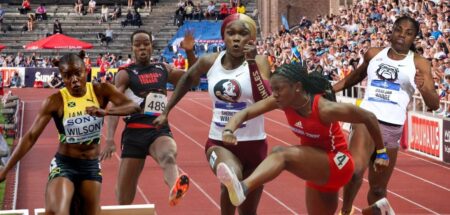



THE JOURNEY – that’s really what this sport is all about for Melissa Jefferson-Wooden. From being a 12-second prep sprinter who got no recruiting attention from the Power 5 schools to the fastest woman in the world, it’s been quite a transformation.
“It’s crazy,” she admits.
The daughter of two preachers from Dunbar, South Carolina (population 923), Jefferson-Wooden has always approached the sport on her own terms and her own timeline. Along the way, she’s always made it clear that it’s family that is most important to her.
In high school, she spent two days strapped to a machine to donate bone marrow stem cells to help her dad beat a blood disorder that could have led to leukemia. “My dad is here and healthy and that’s of the utmost importance,” she says. (Continued below)
Now when she’s not on the track with her friends from Star Athletics, she spends most of her time with her husband, Rolan Wooden, who is also her physio. He, along with her teammates and coach Dennis Mitchell, was a big factor in an incredible ‘25 season.
She sprinted 10.65 and 21.84 in the first double sprint victory at the USATF meet in 22 years. In Tokyo she was even faster, becoming the fourth woman ever to strike gold in both events. Her 10.61 and 21.68 wins were followed up by a gold medal relay.
Now she has put those medals away (“I don’t like to get caught up in it”) and is focused on the next campaign. We talked after she wrapped another day of hard training.
T&FN: Let’s start with an elemental question. What is it in your personality that made you a sprinter?
MJW: In the grand scheme of things, I really don’t know. I guess it’s just something that’s always been in me. It was just a matter of it being brought out, just being able to soar for new heights each and every time. No matter what level I was at, understanding and knowing where I was in those moments and trying to be the best version of myself that I could be and then just allowing that to unlock so many other new things and new adventures.
T&FN: How did you first find your way to a track?
MJW: I was about 5 years old the very first time I started running and I started out doing Hershey Track & Field and I did that until I believe age 13. It was always something that I just did for fun. I was trying to get to the national meet every year in Hershey, Pennsylvania.
I would say I honestly didn’t start to take track very, very seriously until I got to college… well, maybe my junior year of high school. Because by that point I knew that I had a real shot at going to school to run and I knew that was going to be a great way for me to also pay for school. It was like, OK, let’s hunker down. Let’s get locked in and let’s see what can you really do.
T&FN: When did you start noticing the Olympics and thinking, you know, maybe?
MJW: Probably back in 2016. That was my first year doing Junior Olympics, so summer track. And it was a whole new world that was opening up to me I didn’t know existed. Coming from where I’m from, it’s very… just a thought or a dream. And a lot of times, you don’t really have a lot of opportunities where your dreams can actually come true.
I hoped that I would be able to go to the Olympics someday. Did I ever see it happening the way that it did or as soon as it did? Absolutely not. I won’t dare sit here and tell you that because that’s not true at all.
But being put in the right place at the right time, being surrounded by the right people to push me, to encourage me, to uplift me, you know, that’s really my journey. That’s my story. Always looking at where I am and appreciating where I am and knowing that eventually if you keep it up, good things will start to happen to you.

T&FN: Like most kids, you tried other things along the way. And who would have thought that you’d end up world class in this one? Was there any world-class potential with the saxophone? [She was a tenor player in high school band.]
MJW: [Laughs] That’s a funny one. No, there was never any world-class potential with the saxophone. That was just a phase. Growing up for me, it was small town, but I always was looking for things to get into to stay away from being home all the time because there wasn’t really a lot to do at home. So, I was the one who was in the band. I was joining all of these different clubs and finding any way I could stay after school.
T&FN: Is that the story behind the one cross country result I found for you in 10th grade?
MJW: [Laughs] The cross country coaches, they would trick you into trying it. “You know, cross country is a great way to condition for basketball.” And then the same thing with basketball. They wanted you to play basketball because it’ll get you in good condition for track. Obviously they just wanted the kids to participate. It was an experience. I wasn’t afraid to try new things. I tried it; that was probably one of my only races in my cross country endeavors.
T&FN: So, no world-class potential there.
MJW: No. Absolutely not.
T&FN: You ended up winning a few South Carolina state titles at Carver’s Bay. But I don’t believe you were considered elite nationally.
MJW: No, I was never ranked among some of the top athletes in the state because I truthfully wasn’t running the times that they were. For me, 12-flat was all I had and I had to do what I could with that.
T&FN: Did you get much recruiting attention?
MJW: I had a few offers. I got an offer from the Naval Academy. I got an offer from Winthrop University and then obviously Coastal Carolina. Just about three schools and that was all she wrote.
T&FN: At Coastal Carolina, you made steady progress and as a sophomore went to the NCAA meet. A lot of sprinters are at that level. Then in ‘22, suddenly, boom, you have arrived as a world class sprinter. What made the difference that year? Was it coaching, training, health?
MJW: No, I won’t say that a lot changed. I honestly just feel like I’ve continued to just listen to my coach.
T&FN: How did it feel to be the girl that wasn’t recruited by any of the Power 5 schools and suddenly be a national champion?
MJW: It showed me immediately that it doesn’t matter where you start, it’s about where you’re going. Once again, the same thing I’ve been saying and I’ve been going about it my whole life is just trying to be the best version of Melissa that I can be. And that’s when the good things start to happen.
Not necessarily worrying about what others may have versus what I have or how I may have grown up and the resources that I did or didn’t have compared to everyone else. Not focusing on that and just focusing on, “Hey, you love running. This is what you love to do. So go about it as if you love it.”
T&FN: I hear in your voice the love and the determination and the being driven. Is it also fun for you?
MJW: Absolutely. I say it all the time. Track & field is not a sport that you do if you don’t love it. You can’t. You’ll never reach your fullest potential if you don’t love what you do. And I say that would be my biggest piece of advice to athletes that are in high school who want to go to college to run or want to become professional. You have to be able to love, love every single part of it, even the days that suck and that are frustrating and the days that don’t make any sense. You have to be able to withstand all of that because when you cross the finish line and you’re in first place or you got a big PB or your team just won a national championship — all of the things that you just went through to get to that very moment, all of a sudden it doesn’t matter anymore because you got what you wanted in the end and that was to be successful.
T&FN: Was it a tough decision for you to go pro?
MJW: It wasn’t. I just looked at the situation that I was in and what made the most sense for me in my life. Obviously, I don’t come from a place that had a lot financially. I never needed or wanted for anything, but there wasn’t a lot that would change had I stayed in school. I felt at the end of my collegiate journey that I had done everything that I was supposed to do there and it was time to go on to new things.
T&FN: Was it tough to pick out a pro group?
MJW: My first year as a professional I just stayed with my collegiate coach. And there were a lot of different things that I had to learn and a lot of things that he had to learn. It’s not necessarily what we were doing that was wrong. It was more so an environmental thing.
The one thing I have learned and my collegiate coach told me a long time ago is that the higher I go in the sport, the more sacrifices I’m going to have to make. And sometimes it comes down to making the hard decisions. You have to be able to stand in those because at the end of the day, it is your career on the line.
It’s you who’s going to be on the track. It’s you who are going to be the one to have to withstand what the rest of the world sees in how you perform. So I felt like at the time that the best thing that I needed to do was to be in a professional atmosphere and have training partners.
When it came down to picking a professional group to train with, obviously I’m a Nike athlete. So you have maybe three choices. And that was to either come down here to Claremont and train with Dennis Mitchell at Star Athletics, or it was to go to California and train with John Smith, or it was to go to Arkansas now and train with Boogie Johnson.
The thing that made the most sense to me was to come down here to Florida because at the time you have the reigning world champion in the 100. And then you also have the likes of TeeTee Terry, and you have so many other talented and amazing women in the group and you know you’re going to get pushed and challenged every single day. And that’s what I needed.

I needed a challenge. I needed to be pushed outside of my comfort zone.
T&FN: Your first Olympic season as a pro, 2024, was nearly derailed by a stress fracture.
MJW: I missed about 2-and-a-half months off the track. I couldn’t even walk. It was definitely hard and stressful and frustrating.
I was feeling all the feels, even on the days where it was a win. It wasn’t really feeling like that because I wasn’t out there doing what everyone else was doing, you know. And then I finally got to a place where I told myself to just take it one day, one practice, one meet at a time. The reality of the situation is, OK, you’re dealing with this now, but it’s going to get better. This is your floor.
I had to start to tell myself, it’s not about where you started, it’s about where you’re going. And so that’s how I started to approach every day. And then also having my training partners to rely on, like TeeTee Terry and Sha’Carri [Richardson] and Tonea [Marshall] and Kayla [White], they were all in my corner every step of the way, pushing me and telling me, hey, you’re OK, you’re going to be just fine.
T&FN: In Paris, you got a bronze plus a gold on the relay. Considering the stress fracture, I’d call that an A+ season. What grade would you give it?
MJW: My Olympic year, I would give it a B+. I know how far I came to make that team and get on that podium. And even though everyone talks about how my medal was bronze in the 100, in my eyes it was gold because I knew all that I had to endure to get that.
And there’s no better feeling than getting your own individual medal. I love team medals, they mean a lot. But on a professional level, it’s just the individuals mean a little bit more to me personally. I was happy. I was content with how the year went, being with how it started. The reason why I don’t give it an A is because at the end of the day, I’m still a competitor.
I look at my race, I look at how I finished. There were so many things that I still could have done better. I don’t ever want to get comfortable in a situation where I’m just OK with being in the mix. I don’t want to just be in the mix. I want to be able to go out there and win every single time.
I want to be able to go out there and execute my race the way that I know I can. And then now when I go back and I look at my race from Paris… You saw a lot of heart, you saw a lot of grit, but there was no execution there.
And that was the thing that led me into 2025 — Let’s see what Melissa can do with a full healthy year. No setbacks, but let’s also see what you can do when you can actually finish a 100-meter race instead of breaking down at 20 meters left.
T&FN: Did you finally rate an A in Tokyo?
MJW: Absolutely. Tokyo was an A. It wasn’t an A+. It was an A.
“Another Level Of Discipline”
T&FN: If the Olympics had been in 2025, you would be a triple Olympic champion. But now you have to wait 3 years for the next Games, 3 years of working, 3 years of staying healthy. Is that sometimes a daunting challenge?
MJW: Not really. I feel like everything that happens in my life, and especially in my career, is intentional, and it happens the way that it’s supposed to.
In a perfect world, would I have wished that this would have happened in 2024? Yes. But the truth of the matter is, I wasn’t ready for that. And I’m OK with knowing that, and you never know what the next year, the next few years will bring, you never know what may happen.
I feel like it’s another level of discipline where you can really truly appreciate where you are right now in your life. I feel like that’s one thing that I do that separates me from a lot of other athletes.
T&FN: We haven’t seen you indoors in a few years. Is indoors ever going to happen again?
MJW: [Laughs] As long as I’m training with Dennis Mitchell I don’t know if that’s going to happen. It’s the way we train and by the time we get to the end of the year after the season’s over he really likes to give us time for our bodies to rest and come down from all of the training and racing that we’ve done. For instance, the World Championships or Ultimate Championships are so late now, our bodies need to be able to have time to be able to recover and so if we were to start training for our indoor season, it would be really, really hard on us because then we’d probably have to cut our break shorter or come back quicker. I don’t know if a lot of people know about Dennis Mitchell’s falls but they aren’t fun so I’m not jeopardizing my free time. [Laughs]
T&FN: Fair enough. 100 meters or 200, which do you like better?
MJW: Mmmmm, I love the 100. I have a newfound love for the 200 but for right now I’ll pick the 100.
T&FN: You’ve got that undefeated streak in the 100 going from last year. Is keeping that going a big thing for you?
MJW: If I’m being honest it’s really not. It was something that happened and I wasn’t trying to do that. If it continues on, that’s great. If it doesn’t, obviously the competitor in me would be like, Oh man, but you know I never made it a really big deal that I was undefeated. I didn’t realize that I was undefeated until I got to the end of the USA trials.
T&FN: What is it like to train with the world’s fastest training group? Are you with each other 100% of the time on the track or do you do a lot of individual work?
MJW: For the most part, we’re doing a lot of things together on the track. It just depends on where we are in training. When we start to do a lot of speedwork, then you’ll see us start to do things like we’ll run, we’ll have a rep, but we’ll run it individually instead of running it together. And that may be like twice a week or so versus doing it every single day.
But then the base that we build, like when we first come back to training in the fall, and you know, our transition from grass to track, and then once we go from flats to spikes, we’re all in it together. We’re all pushing and motivating each other.
So it definitely has its perks, because then at that point, you’re around everybody every day. And you get to see and be a part of each other’s journey. That’s the thing that makes it so special is that even though we are on our own individual journeys, we’re a part of each other’s journeys. And so when one does good, we all feel good because we see how hard the other one works to get to where they are.
T&FN: Do you hang together outside of training much?
MJW: Yeah, we do actually. We try to, whether that be just the girls, a lot of times we do a lot of group things so the girls and the guys. We were talking about that earlier this week and saying, you know, we need a girls outing or something like that but for the most part we try to do a good bit of things together as a group.
T&FN: Cool. Now one thing that’s obvious is that to be at your level you’ve got to believe in yourself and I’m sure all of your training partners do so as well. But that can sometimes translate to egos and I’m wondering if Coach Mitchell takes special steps to eliminate friction and help things run smoothly in terms of egos that might possibly clash occasionally?
MJW: I think Coach does a good job of managing everybody. Like you said it’s very easy for friction to arise or ego to get involved. But the one thing that he does tell us is that obviously he’s giving us all the tools to be successful. He’s not giving one person more attention than the other or trying to go out of his way to coach someone harder than the next person. We’re all out there trying to get better but it’s up to us to apply that the way that we need to for our own individual careers.
T&FN: Your husband Rolan has been mentioned as a key part of your team. How does that play out?
MJW: So he’s my massage therapist and he travels with me as my physio a lot of the times which is great in so many different ways. I have someone obviously that I trust a lot. For a long time we’ve known each other as just partners. But now it’s another thing and I feel like it’s also a plus to have him as my physio as well because we spend so much time together so he can tell when something’s off.
He can tell when something isn’t right. He can be the one to say have a quick conversation with Coach and be like, Hey, watch the way that her hips are dropping or something like that. It’s just little things like that when you’re around someone every single day you know they could be able to decipher those things and create a really good communication between not only you, the wife and the client, but also with the coach as well. This really is one team and together it can be a really well-oiled machine.
T&FN: Has your success in Tokyo changed you in the way you look at your career?
MJW: No, not necessarily. Sometimes I have to remember that I did what I did last year. I’m not trying to just overlook what I did, obviously because I’m very grateful. I worked really hard to do the things I did last year, but I don’t like to get caught up in it.
It’s a whole new year. Track & field changes every day. There’s always going to be someone who’s fast right now versus who’s fast later. And I just want to be able to stay focused on where I am right now.
One thing I probably should do a better job of is having a balance. Sometimes I get a little too focused on not trying to dwell on what has already happened in the past and being able to talk about it but not feel like I’m just obsessing over it. If anything, that would be the only thing I feel like has changed. The one thing that I am working on this year is just trying to find that happy medium. □