


– Advertisement –
By Azara Lavia
In observance of yesterday’s World Food Day 2025, Antigua and Barbuda launched a three-week training program on Agricultural Water-Saving Irrigation Technologies, aimed at promoting sustainable water management and strengthening food security in the twin-island nation.
The initiative is a collaboration between the Ministry of Agriculture and Longping High-Tech Agriculture Coompany Ltd of China.
The opening ceremony, chaired by Anika Aska, featured the national anthems of Antigua and Barbuda and China, reflecting the close partnership between the two countries.
In his feature address, Dr. Weng Yong, Executive Vice Director of Longping High-Tech International Training Center, highlightedthat the program’s focus is designed to address Antigua and Barbuda’s dry climate and coral rock soil conditions through the introduction of modern irrigation technologies such as drip, micro and fertigation systems.
“The program emphasizes knowledge transfer, hands-on training, and sustained technical support rather than short-term aid,” Dr. Weng said. “Adapting successful models from Africa and Asia to local conditions ensures long-term benefits for farmers.”


He quoted the late hybrid rice pioneer Yuan Longping, saying, “the roots of hybrid rice are in China, but its branches and leaves should extend to the whole world.”
Speaking on behalf of Director of Agriculture Gregory Bailey, Permanent Secretary Walter Christopher noted that the program aligns with national policy objectives, including efficient water use, rainwater harvesting, dam construction, and soil and water conservation.
He emphasized that with over 90 percent of Antigua and Barbuda’s water supply sourced from reverse osmosis, adopting smart irrigation technologies is crucial.
A video presentation showcased the shared history of agricultural collaboration between the two nations.
Director of Economics and Commercial Affairs Chang Yun, the Honorary Consular Officer at the Embassy of the People’s Republic of China, described the program as a practical example of cooperation that benefits both countries and promotes sustainable development.
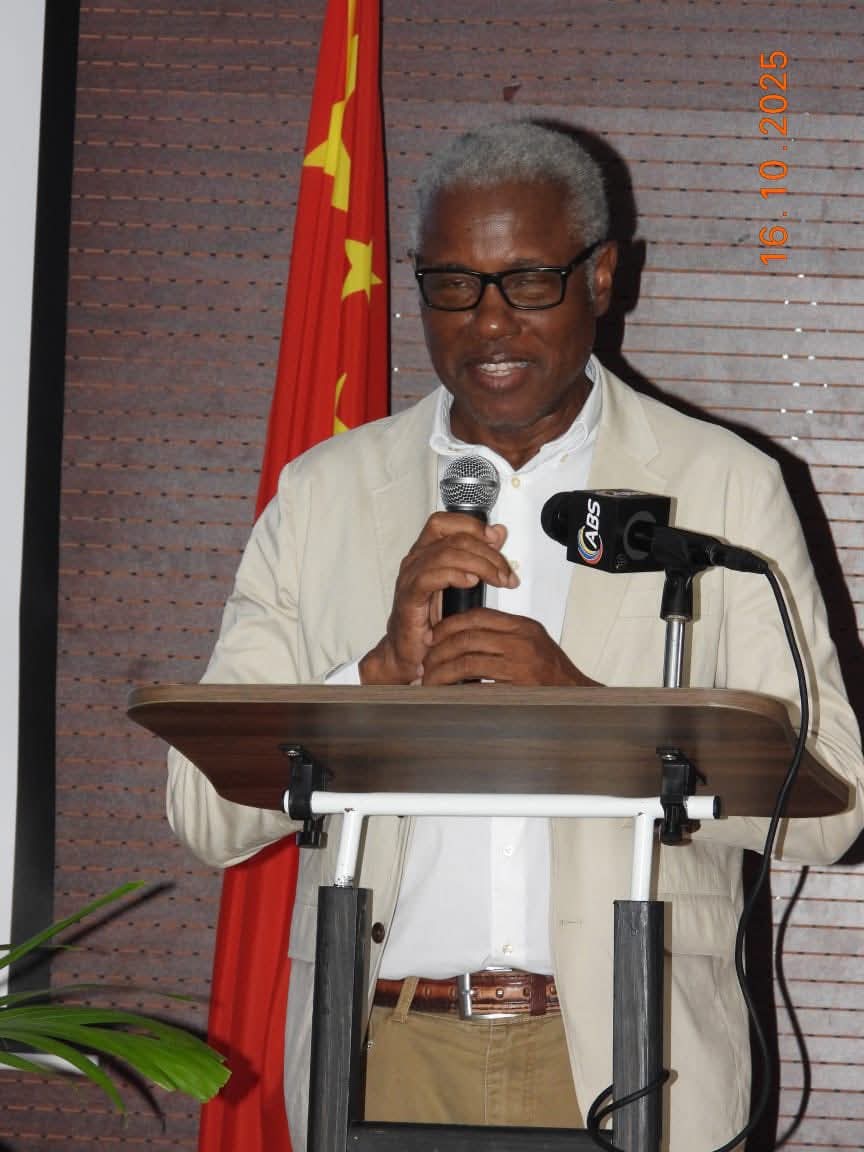
Ambassador-at-Large H E Dean Jonas called the initiative a timely response to global challenges in food production, highlighting the importance of responsible water use and innovation in agriculture.
“Oh, this is absolutely important for Antigua. You see, the challenge we face with agriculture in Antigua is the number one input, water. We are a drought-prone nation. And unlike our friends down in the Wynwood Islands, you know, St. Lucia, Dominica, and so on, where they have the high rainfall, Antigua has very low rainfall. So this training course is essentially about using less water to get the same level of productivity. So it’s actually a technology transfer,” Jonas said.
“And as I said in my speech earlier, this really is a generational type of training, because, the farmers here today who will learn this technique will be able to pass it on to their next generation of farmers, this new way of farming with less water.
“So it is really something that is very, very important and beneficial for Antigua and Barbuda, because the techniques that we’re going to learn today will help us for generations to come”.
Tied to this year’s World Food Day theme “Water is Life, Water is Food: Leave No One Behind”, the training program demonstrates the twin island nation’s commitment to sustainable agriculture and long-term food and water security.
About The Author

– Advertisement –