

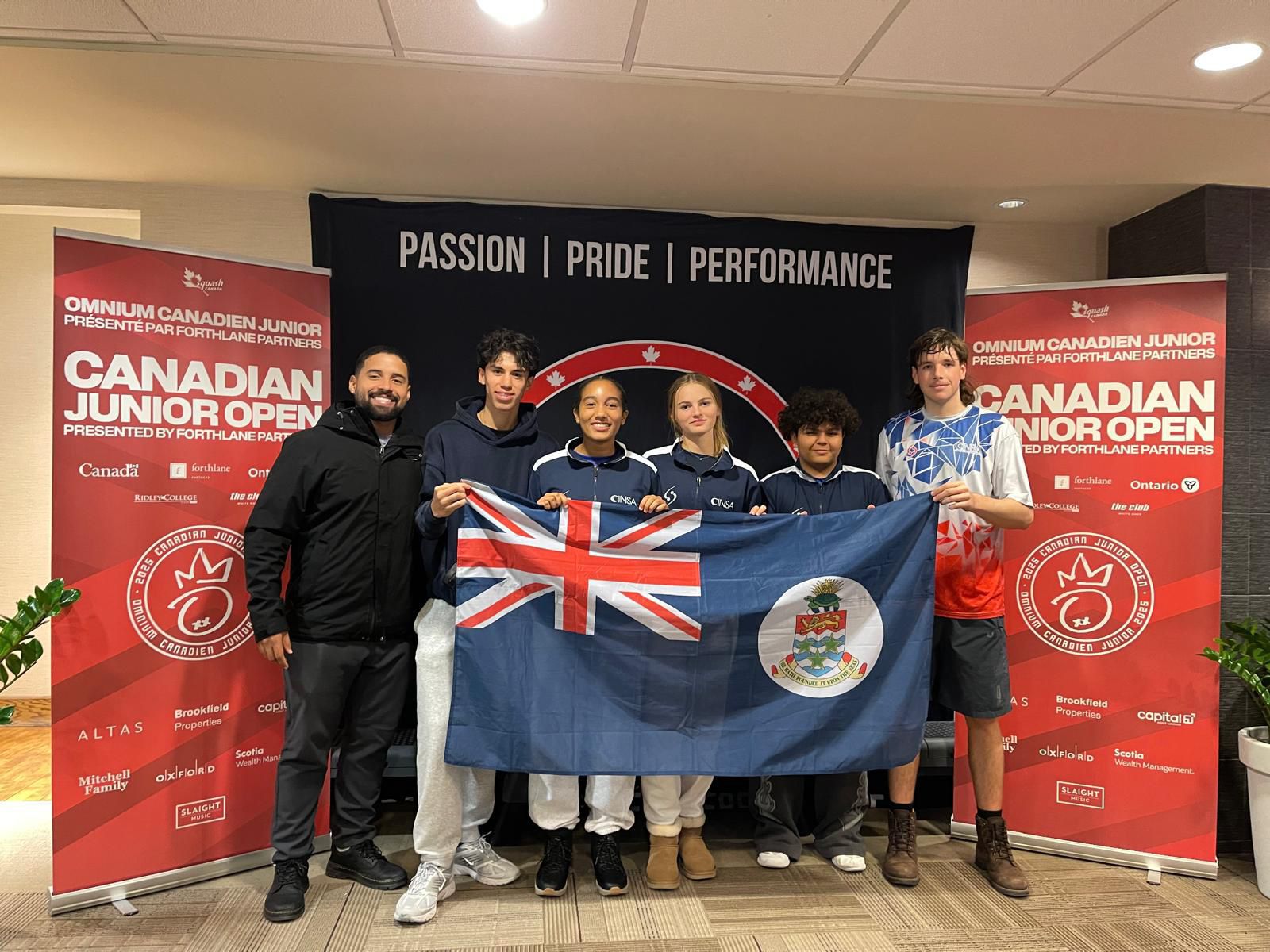
Cayman’s junior squash programme recently took a significant leap onto the global stage at two prestigious North American competitions – the US and Canadian Junior Open.
The journey began in Niagara-on-the-Lake, Ontario on 13-16 Dec., with a five-member contingent comprising Maximillian Woolf, Claudia Bullmore, Gavon Ramos, Kaylee Pierre, and Brodey McComb.
Each Cayman player recorded match wins during the tournament with Woolf leading the charge with five victories, followed by two wins each from Pierre, McComb and Bullmore, and Ramos bringing in one win.
This collective effort saw McComb reach the plate final and both Pierre and Bullmore advance to the quarter-finals.
Assistant junior national squash coach Julian Jervis, who accompanied the players to both Opens, said, “The objective of this trip was not to assess these juniors on their wins and losses; however, our juniors at the Canadian provided the added bonus of exceeding expectations and winning a combined 12 matches.”
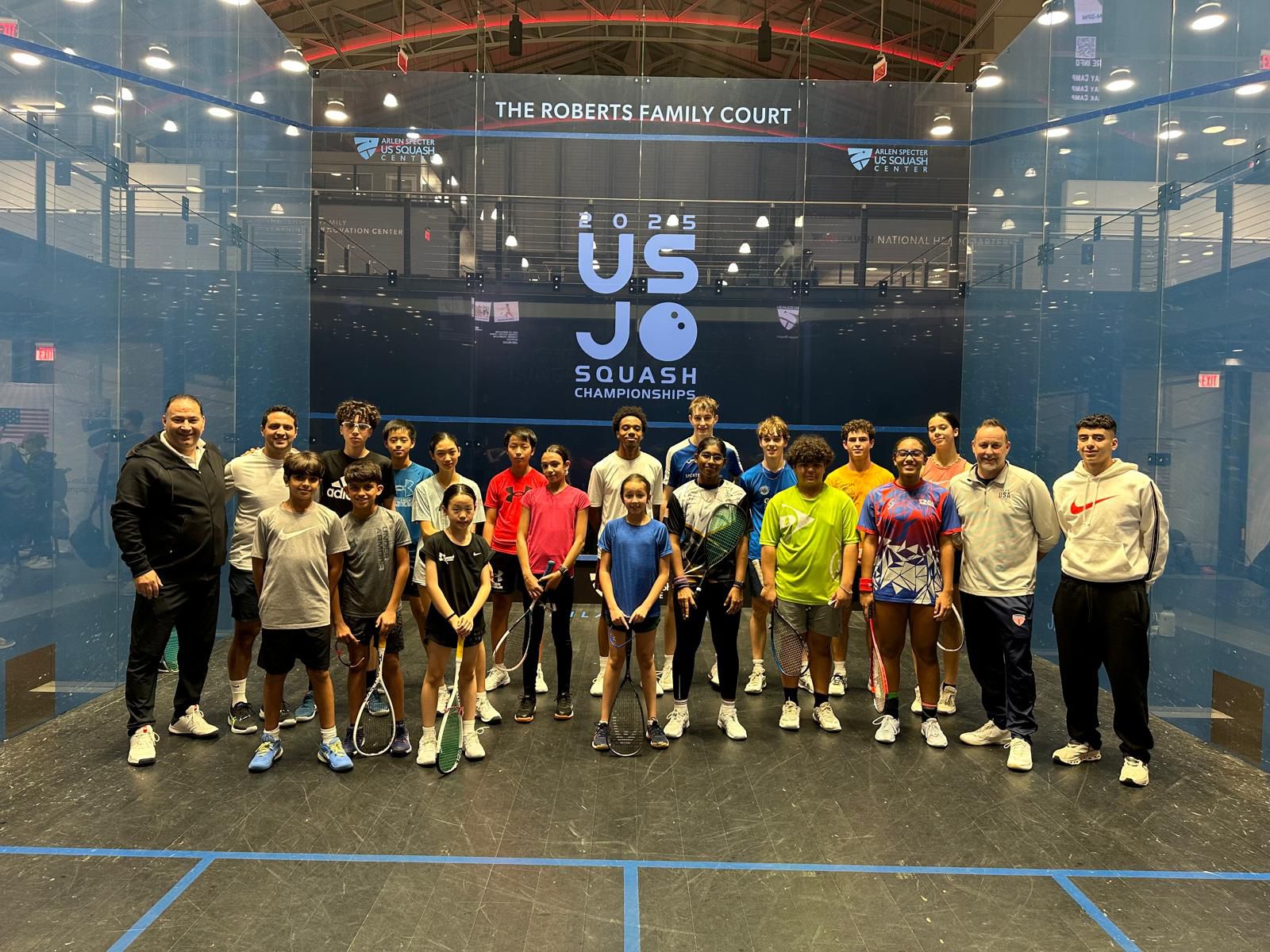
Entering the US Open with ‘less expectations’
Following the success in Canada, the focus shifted to the US Junior Open in Philadelphia, Pennsylvania, held on 20-23 Dec.
“The US Junior Open is nearing toward a point of being considered the most prestigious junior tournament in the world alongside the British, so we went to that tournament with even less expectation than the Canadian and with fair reason,” said Jervis.
He added, “That being said, the juniors showed tremendous courage and grit to battle it out with whoever was put in front of them, impressing other countries and their coaches in the process.”
The three Cayman athletes to compete in the US Open for the first time were Maximillian Woolf, Kaylee Pierre and Sienna Scarpa. Competing in the boys under-15, girls under-15, and girls under-13 divisions, respectively, the trio faced an elite level of competition that pushed them to their limits.
While the final results did not yield match wins, Jervis said he’s “happy with the juniors’ performances but, more importantly, … that they are hungry for more and keen to improve.”
He added, “As much as they were shown another class of squash to what they’re used to, they saw that it is the same tactics, techniques and patterns that they practise here at home, these juniors just commit more time, effort and focus to their training and, as I tell [our players], those three things are 100% free. That is the most important lesson I wanted [them] to take away and that was accomplished.”
Jervis said the “largest problem with training on a small island” is the lack of exposure to competition, new and higher-level players.
“So I sympathise with them not having the scope to see the bigger picture on the day-to-day and struggling to find the hunger to train as hard as they possibly can and savor every moment of training,” he said.
Regardless of the “quality and energy” added to his training sessions, Jervis says “it’s only half the puzzle”.
“The other half is the vision and the goalpost that motivates the kids to be at their best. Competing at the US Open pushes that goalpost and incentives like these tournaments mean everything.”
Jervis says, “With a revitalized Cayman Islands National Squash Association since COVID, Cayman squash has been in a rebuilding phase as our goal is to build a thriving competitive national team comprised of many elite Caymanian juniors.”