


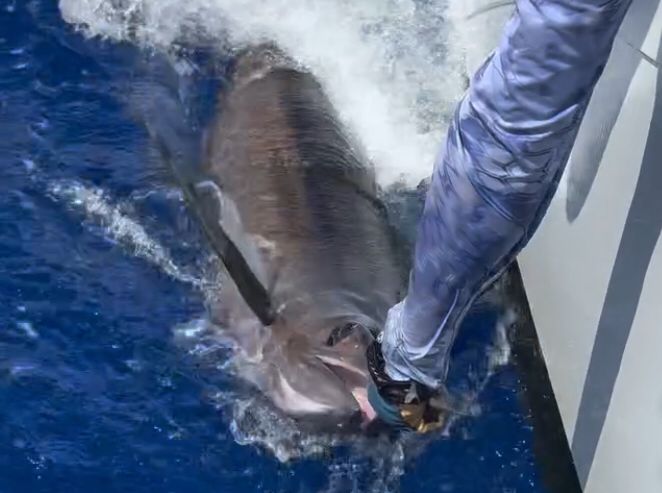
From scooping up minnows in the pond near his childhood church to reeling in grunts on a handline from the South Sound dock, fishing is in Captain Jacob McTaggart’s nature. But battling blue marlins in the recent BK Big Fish Tournament was another story.
McTaggart was at the helm of the conservation efforts during the tournament, catching and releasing three marlins — the most from any angler during the event.
His boat team, Naut Wurkin, was recognised as the Blue Marlin Releases winner of the tournament.
“It’s a little bit of recognition, which is nice because we do spend a lot of time out here, but apart from that, it doesn’t really mean that much because it’s more of a process,” McTaggart told the Compass.
He acknowledged that the decline of marlins worldwide is a sad reality, but said that the catch-and-release initiative established by BK Big Fish is a step in the right direction in assisting the species’ continued existence.
“Marlins are a very slow-growing fish, but can get fished out very easy,” he said, noting that marlins, which can get up to 2,000 pounds, are better alive than dead.
“It makes sense to release a fish like that, especially for tourism. Marlin is a world-class fish, so the more we have around here, the more tourists will come here.”
According to the International Union for Conservation of Nature, blue marlin is considered a threatened species due to overfishing — a situation BK Big Fish organisers took seriously when making the rules for the tournament.
For McTaggart, who owns a charter company, it’s easy to see the importance of preserving the ocean’s giants. He, nonetheless, enjoys a good “tight hand” before letting them off the hook.
“No marlin is the same. Some can fight very hard, some come in easy, regardless of the size,” he said.
“You can have a 200-pound fish that schools you and have a 400-pound fish that you just wait for 30 minutes to get them to the boat.”
One of the fish McTaggart hooked on his boat proved to be more difficult than the rest, with a battle that lasted more than an hour.
“One didn’t really take off,” he said. “It conserved its energy to the very end and, no matter how hard we tried to get him alongside the boat, he decided to do something else. We would have him on one side, and he would swim under the boat, and we would have to walk around with the rod, and then he would come up on the other side and jump. He was very difficult.”
Throughout the tournament, seven marlins were caught and released, with McTaggart catching almost half of that batch. And it could’ve been more, according to McTaggart, who admitted that a few got away.
“We hooked at least three others that got away,” he said, “and we had a wahoo cut through one of our leaders, but that was it — three days, three fish.”
He thanked his team, saying, “I couldn’t have done it by myself. It was clockwork. … Like I said, teamwork makes the dream work, and that is what happened.”