



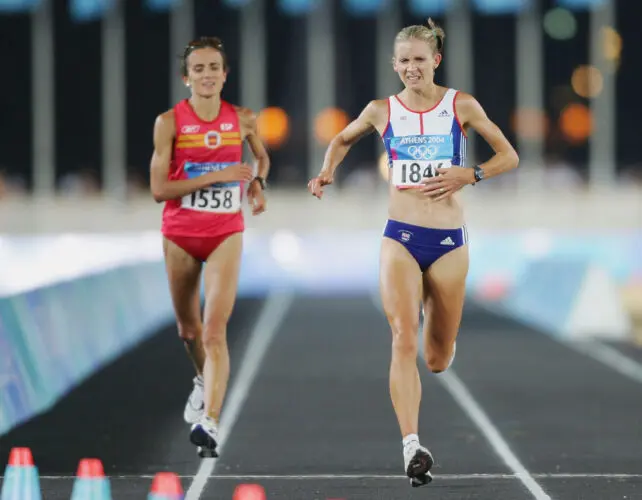
British distance runner looks back on her 25th place with 2:40:13 at the Athens Olympics in 2004.
The Greek capital was the scene of only the Briton’s second outing over 26.2 miles after landing the Olympic qualifying time on her debut in Berlin 11 months previously. While she finished almost 14 minutes adrift of Japanese gold medallist Mizuki Noguchi, lasting the distance was an accomplishment when others – notably team-mate Paula Radcliffe – came unstuck in the punishing heat.
I got an injury early in 2003 when I tore my Achilles during a really hilly cross-country race. I wasn’t able to be fit enough in time for the track season because of it, so it forced my hand to think that a marathon would be pretty well-timed in terms of the recovery.
Berlin came to mind. It was always in the third week in September, so the date was set. The Olympic qualifying time was 2:34 and I was convinced I could easily run that. I spoke to Paula a little bit about preparation and nutrition and got myself on the start line. It was nothing like anything I’d ever done before. I was putting all my eggs in one basket but I ran 2:30:58 with a toilet stop to finish eighth and bagged the qualifying time.
Qualification wasn’t as straightforward as that, though. London, staged six months later, was the official trial and I didn’t want to run so close to the Olympics. Instead, I paced the first part and then went to my hotel room to watch, just hoping that they didn’t run a faster time than I had.
That was a pretty tense moment. Tracey Morris was the 40-year-old who qualified for the third spot available as first Brit that day with the qualifying time. Paula and I were selected based on previous performances that year. It was a high-risk strategy.
I did have a long build-up to focus on Athens. You have to know a lot about your own ability to peak at the right time and to know what works for you but going through my first marathon cycle really taught me a lot about peaking and resting, which is great for coaching now as well.
Having no other distractions is really good in some ways but, in others, it’s quite high pressure because you’ve got one focus and you can’t deflect it with: “Oh, I’ll just do another one next week.” It doesn’t work like that with the marathon.
Athens was always going to be very hot, so the training had a lot to do with heat adaptation, and we had lots of sweat testing done to make sure that we were getting the balance of electrolytes right. You’re using up more glycogen in the heat, as well, so it’s trying to ensure that we were also fuelling in the right way, dealing with the conditions that Athens was going to throw at us.
The focus was a lot on pace endurance, a lot of long repetitions with short recoveries. Some sessions would be six x six minutes or 10 x three minutes – quite standard sessions with 60-90 seconds recovery – but also lots of longer tempo runs. I would do a midweek 15-mile hilly run, which was probably done at around six-minute-mile pace, and then a longer run at the weekend.
Qualifying for a major championships is probably the most stressful part but, once you’ve qualified, you can relax and just get on with the job. With that stress removed, it moved more into excitement and anticipation.
An Olympics is pretty unique because you’re in an Athletes Village surrounded by all of the world’s most incredible athletes in all their different sports. There are all these super-humans just walking around and then to actually realise that you are one of them is very, very surreal.
But with everything that surrounds the Games, starting with the training camp, you are made to feel quite special. All you have to do is the training. There’s no day-to-day grind to deal with and you have a clear path to just focus on the job in hand.
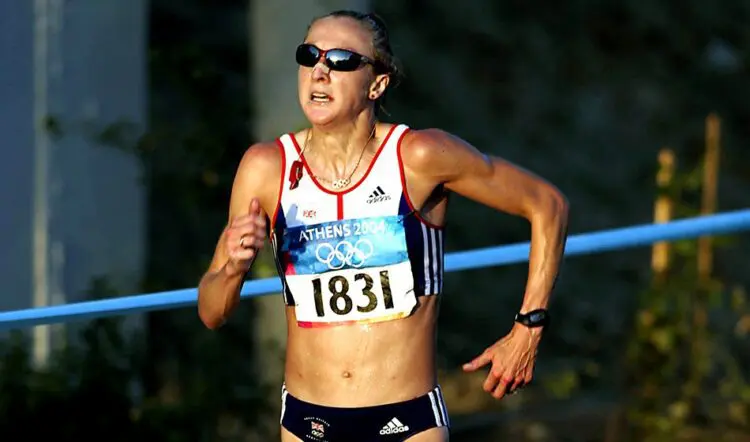
We raced at 6pm in the evening, which was another curveball, because normally we’re used to running in the morning. It was like: “What do we eat?” I think I ate three bowls of porridge throughout the day. Then, on the start line, it was 40 degrees and the new tarmac road was giving off 50 degrees, so it was really intense.
Paula was expected to do extremely well so there was a lot of stress and pressure surrounding her at that time. I could just sink into the background. I was nervous, of course, but I was excited. And I like extreme conditions because people who are usually at the front may not be and some people can do well in those kinds of conditions. I liked that unknown entity from the challenge that Athens threw up.
I did the best I could have done on the day. My time was nine minutes slower than my best from Berlin, but I didn’t really slow down significantly. I ran a fairly even-paced race, and I was the first Brit home. I didn’t know until afterwards that Paula had been forced to drop out.
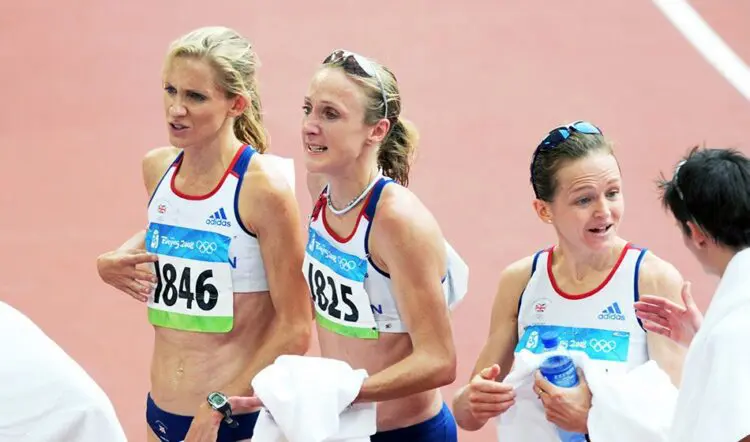
If I had been wiser and I’d done more marathons, I possibly could have run faster, but I was fairly inexperienced so it was a really good springboard to prepare properly for Beijing four years later. It wasn’t to be there because I got tripped at the 15km mark but I was in the shape of my life going into those Games.

I loved the fact that, in Athens, we were supposedly running on the original route. We were finishing in the Panathenaic, the original Olympic stadium. Initially, I was a bit disappointed that we weren’t finishing in the main athletics stadium, but coming into that was incredible. I can still picture it now, running around, thinking what had gone on in that stadium years and years ago. It was just really fitting. A real privilege for my first Olympics and my second-ever marathon.
Liz Yelling performs running and triathlon coaching – learn more at yellingperformance.com


