

This year, the inaugural Jerome Gillbard medal was presented at the Australian Men’s and Mixed Netball Association (AMMNA) Championships in Perth. Its purpose is to recognise a talented male netballer who creates opportunities for others, and there could be no more fitting tribute for Gillbard, who has done so much to develop the men’s game. State and national athlete. Fever training partner. Club official. Pathway development. Badged umpire. Gillbard has done it all.
His story started in a small rural Western Australian town, where he played the game until he was twelve. Unable to compete against women beyond this age, he found it tough to give up but put his playing days behind him, until a mate asked him to fill in for a social team.
“I’d been out of the sport for so long I’d almost forgotten about it and the love I had for it,” Gillbard said. “I had no choice at the time. But I fell straight back in love with it.”
As part of a strong mixed netball scene in Perth, Gillbard was playing for up to eight social teams, travelling hundreds of kilometres across Perth each week to get his fix. At the time, the 196 centimetre shooter had no idea that pathways had started to open up for men in what had traditionally been a female dominated sport.
“Someone told me that there were competitive state based programmes and men’s nationals and that I should try out for them. I was like, ‘I don’t think I’m good enough for that. It’s not for me.’
His interest was piqued enough however, that he went along to try out, and made the grade.
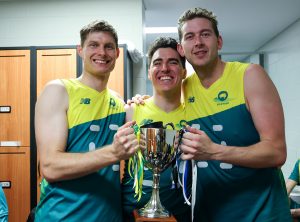
Kelpies Daniel Cools, Dylan McPherson and Jerome Gillbard with the Trans Tasman trophy. The three West Australians were Fever training partners. Image: May Bailey I Clusterpix
When Gillbard first represented Western Australia in 2013, the state was part of a smaller break away group that included South Australian and South Queensland teams. With WA not represented at the 2014 AMMNA Championships, Gillbard was allowed to take the court for NSW when they needed an injury replacement.
“Seeing how big that competition was, how many men and boys were playing, the amount of talent, athleticism and skill was such an eye-opener for me.
“That really drove my mission back here. I didn’t want to go back as an import, I wanted a WA team to play in that.”
Gillbard became part of a small group who set the wheels in motion for WA to enter the big leagues. They established new pathways, went on to join the national competition in 2015 and the state hasn’t looked back.
When he started playing competitively, Gillbard received an invitation to train with West Coast Fever that would change his life.
Western Australia became the first state to welcome male training partners into their national league side, a brain child of then-Fever coach Stacey Marinkovich. It was a complementary pairing – the men played a more aerial game, while the women were more skilled – so they learned from each other.
“I have so much gratitude,” Gillbard said. “To Stacey for being so welcoming, so accommodating and inviting me really early on.
“And that’s built and exploded from there, both in WA and across all the SSN clubs and now into the Diamonds’ programme.
“Men do bring a bit of difference in the way they play netball, and the way they approach it. The women are very clinical, drilled, very well structured and super professional in the way they approach and play the sport. That’s something that we in the men’s side have really tried to emulate.”

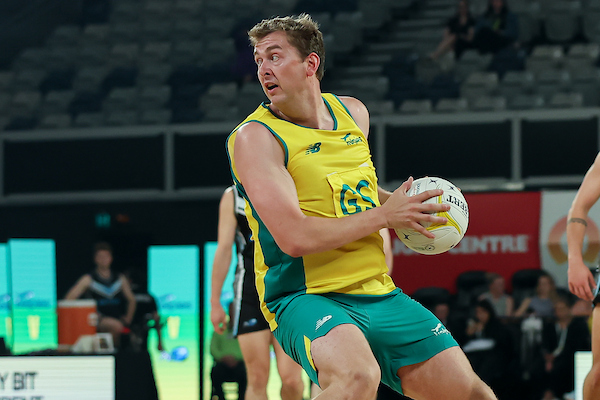
Jerome Gillbard was strong under the post for the All-Stars, a mixed team which played West Coast Fever. Photo: Mia Mammoliti
While the male training partners are unpaid and volunteer for love of the sport, there are some side benefits, including access to top level coaches, support staff and quality training facilities. For Gillbard, that included an introduction to Liam Warwick, Fever’s long term Head of Performance.
While Gillbard was a gifted netballer, his physical condition impacted his performance. He said, “I’d struggled with my weight for such a long time. In my first year with Fever I was still quite heavy, probably in the obese range to be honest.
“I loved competitive netball so much. I wanted to go places with it, to play as much as I could. I wanted to win. And recognising that to do those things and be great at the sport, I had to change the shape I was in.”
Intrinsically motivated to improve his strength and conditioning, Gillbard still sighs at the memory of working closely with Warwick, who helped him to lose around 50 kilograms. “If Liam had asked me in those sessions I probably would have said I hated every minute of all the running and the gym.
“But I lost a significant amount of weight, and became as strong and powerful as I’ve ever been. The access to Liam and to the training environment, and the resources, yeah, that was phenomenal.”
At training Gillbard mimicked the towering shooters that Fever defenders would come up against, while continuing to add to his own skill set. National selection followed fairly quickly – he’s been a regular in the Kelpies (formerly Sonix) since 2018, and recently notched up 100 games for the WA state team.
While Gillbard’s height is an advantage under the post, he also brings an incredible netball brain to the game. As a self-described netball student, he’s appreciative of the many influences that have shaped his thinking. “Watching so much of it growing up, my mum played, but also honing it through the exposure I’ve had to so many athletes, coaches and teammates who think differently. They’ve really challenged me and that’s helped me integrate other aspects into my game.”

Gillbard gets airborne. Image supplied by Jerome Gillbard.
Gillbard believes that netball is the ultimate thinking person’s game, with every person needing to contribute. “You can’t hide behind one or two stars, which some sports can. Everyone has to do their job for a team to be successful, and I’ve always loved that.
“The game is technical, you have to think, and I’ve always enjoyed the challenge of trying to work out an opposition, what they’re doing, and how our team or myself individually can do to combat that or minimise their impact.”
The men’s game is very much in a development phase around the globe, and is currently one of the most rapidly growing sports in Australia. For some, it’s still highly athletic but a safer alternative to the concussion issues that are impacting contact sports, while for others it’s about the inclusivity or the friendships they make along the way.
All of those factors are important to Gillbard. He says, “We’re under no illusion that netball has traditionally been a sport built for women, by women.
“No male who plays the game wants to take any of that away. We just want to be there, to show up and also contribute to the women’s game.
“When we’re invited into a women’s training, can we challenge them in different ways, or provide match-ups that they might come up against at a Commonwealth Games, or an SSN fixture, so that when they do play those athletes, they’ve already had some practice.
“We also want to emulate a professional netball environment. If we want to be taken seriously by potential sponsors, partners, fans and stakeholders, it’s important that we see what we can learn, how can we be better.”

The Diamonds and Kelpies shared a training camp in 2024. Gillbard is pictured alongside Australian Diamonds captain Liz Watson Image supplied by Jerome Gillbard.
In Gillbard’s experience, the inclusivity that netball demonstrates is second to none in any sport, although he believes there is always room for improvement. In the men’s game, that involves building better pathways for boys and young men to follow.
After seven years representing Australia, usually alongside shooting partner in crime Brodie Roberts who he describes as a phenomenal athlete, Gillbard announced his national retirement in late 2024. He’d been toying with the idea for almost a year, and just wasn’t sure when the right moment would come.
“I had a few annoying little injuries that hadn’t interrupted my full buildup, but had impacted me enough that I wasn’t happy with where my body was at.
“I didn’t want to linger around getting injured, not being able to perform at full capacity. So I wanted to go out playing good netball and just loving my time in the Kelpies.
“And I’d set some goals when I took over running the men’s programme in WA. I’d sort of ticked all of those too.
“I wanted to soak up the moments while I was still playing well, and contributing to the team in a meaningful way, and that helped make the decision for me.”
While his final series was a white-washing of New Zealand, Gillbard went out on a high. With his uncanny skills on full display, he was awarded MVP in the first game, and a fitting tribute from teammates and fans in the last.

Eight years on court in the circle. Brodie Roberts and Jerome Gillbard having a chat during their last match. Image – May Bailey/Clusterpix Photography

Saying farewell to a friend – Jerome Gillbard retires from international netball. Image – May Bailey/Clusterpix Photography
Gillbard works as a psychologist away from the court, but he’s found time to follow up other netball opportunities since his national retirement. One of those was a few weeks in Jamaica in their Men’s Netball Premiership earlier this year. With some heavy hitting sponsors* on board, tournament organiser Shawn Murdoch was able to invite players from around the Caribbean, plus several from Australia and England.
Murdoch said, “After Jamaica dominated the America’s Championship we saw a need to invite other players from the region so they can keep pace with the growth of men’s netball. Since we were going to have imports, we thought we’d go further afield too, and it’s been an absolute success.”
Arriving a week before the tournament started, Gillbard spent time training with his team before the two weeks of match play got underway. He said of the experience, “It took a while for me to gel with the different style of play, but I had so much fun. The country was lovely, the people friendly and welcoming. The atmosphere and vibes at their games were phenomenal.”

Jerome Gillbard loved his time as an invitee in Jamaica. Image supplied by Jerome Gillbard.
Gillbard remains heavily involved in the local netball scene, both playing and umpiring state league in Perth. As an A grade badged umpire, he probably remains one of the few people who has both played and umpired at the same tournament. And while he’s resigned from his long standing presidency of the West Coast Warriors Mixed and Men’s Netball association, he’s more recently been involved in setting up men’s divisions at Rangers.
In such a wide-ranging and illustrious career, Gillbard is pushed to pick out some of his career highlights. And while he describes playing for the Kelpies as a huge privilege and honour, and winning a national title with WA as exciting, the growth and development of men’s netball across Australia and globally is right up there.
“To think that I contributed in some small kind of way is pretty special,” says Gillbard. Ever humble, he understates the role he’s played in growing the men’s game. And that’s okay, because with the introduction of the Jerome Gillbard medal, his legacy will never be forgotten.
*Murdoch would like to acknowledge sponsors of Jamaica’s Men’s Netball Premiership, as without them the invitational tournament would be unable to take place. They include: InterCaribbean Airways, PowerAde, Caribbean Dreams and St. Kitt-Nevis-Anguilla National Bank.
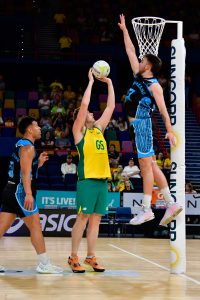
Net Blacks GK Dylan Bartels getting air time over the shot of Jerome Gillbard. Image – Simon Leonard

Gillbard with his family members during his farewell tour with the Kelpies. Image supplied by Jerome Gillbard.