


“We used to joke that it was a competition to see who’d put their toast in the toaster first for breakfast.”
Former Diamonds’ captain Laura Geitz remembers how winning was at the forefront of her teammate’s minds at the 2015 Netball World Cup. They were brilliant, motivated but ultra-competitive elite athletes – even when it came down to making breakfast.
“It was so full on. You’re living with these girls that are such great friends, but we were literally living and breathing netball every second with each other.
And as she and the team celebrate the tenth anniversary of their victory, it’s those funny little moments that they’ll remember, every bit as much as Australia’s successful campaign.
Leading into the Sydney based event, from outside the Diamonds looked like they were riding high – the team had been undefeated in almost two years, with an emphatic 18 goal win at the previous year’s Commonwealth Games.
Inside the camp however, the pressure was enormous. Defending their title at home, several players – including the captain – who were out of form or had limited court time, two serious injuries needed managing, the previous loss of in-form wing attack Madi Browne to an ACL injury, bringing in Paige Hadley from outside the squad to replace her, one pregnancy and three players contemplating retirement.
On top of that was the need to manage the demands of media, sponsors, fans, activations and promotions, leaving the players and support staff at risk of burnout.
Geitz said, “Usually we only have to manage these things in short bursts at test matches. But we were pushing ourselves, wanting to win, and it was so intense and full on for every single person involved.
“We’d just come out of our ANZ campaigns. Eight of us played in the Firebirds-Swifts final and it was a rough game. I remember playing against Kim Green in the final up here in Queensland and absolutely having a few biffs on court. Then next week we’re captain and vice captain on the same team.
“I remember thinking, ‘this isn’t normal, I hated you last week,’ and now all of a sudden we’re back on deck, on the same team, and having to come to terms with everything we were dealing with.
“It was a huge credit to all the girls and everyone we had around us.”

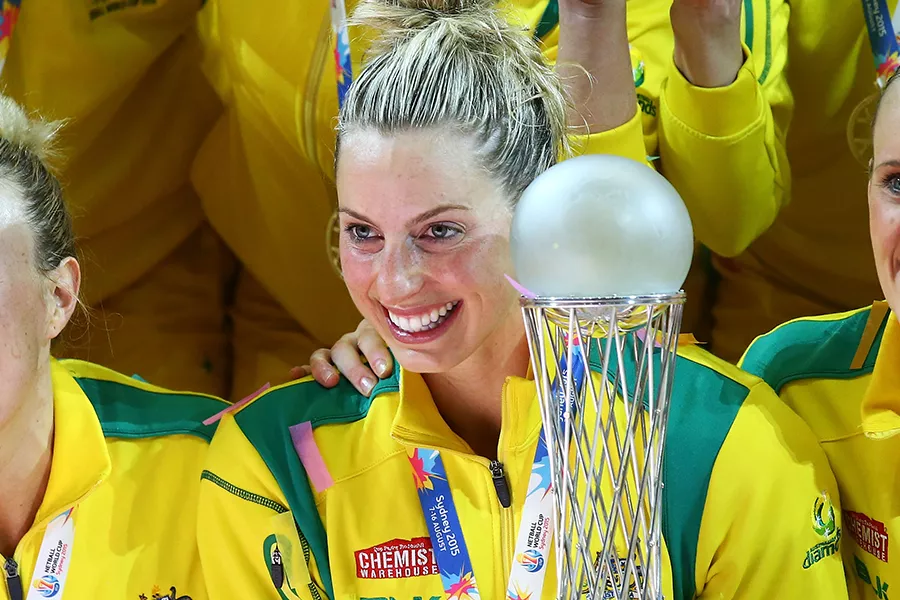
The Diamonds celebrate their 2015 Netball World Cup win. Image supplied.
—
POOL PLAY
With so much going on in the background, national coach Lisa Alexander and her support staff did their best to recreate some of the comforts of home. Apartment style accommodation gave them access to their own rooms, a kitchen to prepare food in, a treatment room, plus space to have time out when they needed it.
“We didn’t say much to the outside world (about the pressures we were facing),” said Alexander, “but we committed to taking care of every detail we could so the players could perform at their best. I remember we didn’t get some good coffee sorted though – of all the things not to think of!”
One of the toughest challenges was the injury to Julie Prendergast (then Corletto), who Alexander saw as indispensable to their campaign. Suffering a stress reaction in her foot, Prendergast was in a moon boot which limited her ability to get out on court. It was a hugely frustrating time for the goal defence, which left her questioning her value to the team, while 13th player Clare McMeniman unselfishly trained on in the background in case she was needed as a replacement.
According to Alexander, “Julie is such a team person, she said to me, ‘Look, do you think it’s a good idea taking me? Because I am going to be restricted.’
“And I just said, ‘No, I don’t think we can win it without you.’
“Our team understood that as well. And Julie wanted to train, but getting her to understand that it was okay for her to train and play differently was a challenge.”
The earlier rounds in the World Cup were used to smooth out various combinations. Erin Bell was back in the side after missing the previous year’s Commonwealth Games, and Caitlin Thwaites was a completely different style of shooter to Caitlin Bassett.
Defender Rebecca Bulley had received limited court time for the Firebirds, Geitz had been out of form, the Diamonds were adjusting to life with Hadley instead of Browne, while Kim Green took over Browne’s wing attack role and had to adapt to playing alongside key shooter Bassett and goal attack Nat Medhurst.
Alexander said, “Kim and Nat are both extremely intelligent attacking players, who like to possess the ball a lot and in combination they could either be brilliant or awful. We had to get them working together, to know what would be best to get through the walls of defenders they were facing. So they spent a lot of time looking at video together, and making little tweaks to their game. I think they did that so well.”
Drawn in a pool with New Zealand, after two undefeated years Australia suffered a shock 47-52 loss against their arch-rivals. While part of the issue was gelling combinations together, looking back Alexander believes complacency was their worst enemy.
“I think we thought that we’d just get through the game, because we had such a winning streak against them. We only had Julie for half the game, but it almost felt like we were going through the motions. So having that loss really sharpened us up.”
Geitz said that no one was panicked by the result – rather, it was a pressure valve for such a long winning streak. “It really shaped the way the rest of the tournament went for us. Most of the team were playing the best netball they’d ever played in their careers, we had momentum.
“Through the work that we’d done with Leading Teams, we’d developed a culture of being able to have really honest conversations, no matter how difficult. And when you’re winning, you don’t need to have them so much.
“So that loss, it was a real kick up the bum. We didn’t have long to turn our performance around, but we looked at what we could learn from it. It wasn’t the easiest thing to do but we knew we were only as good as our last performance.”

Julie Prendergast and Laura Geitz were a lethal defensive combination at the World Cup. Image: Netball Australia
—
THE FINALS
Australia easily accounted for England and South Africa as they moved through the World Cup, then had a bruising 11 goal win over Jamaica in the semi-finals. Battered and sore, they faced New Zealand in the following day’s gold medal match.
Going into the final, Alexander included both Corletto and Green – who’d also been battling a nasty lower leg injury – in her starting seven. She also had to make the difficult decision whether to run with her out of form captain, Geitz, at goal keeper, or Sharni Layton, who’d been tearing up the court.
Alexander had built strong relationships with her players, and knew them well, particularly after her former role as the Australian 21s coach. So she knew exactly what Geitz was capable of in big matches, despite the captain’s doubts.
“Laura came to me and said, ‘Do you think we should start with Sharni?’
“And I said, ‘No, I think we need to start with you.’
“I knew by the look in her face that she was ready to go. If I hadn’t seen that look it might have been a case of putting Sharni out there who could have done a brilliant job as well. But Laura was on, and she was just so good, particularly in that first quarter.”
While Geitz knew the match would be a sixty minute grind, she had a strong feeling about the result before the first whistle even blew. “I remember we were in the huddle. You’re so focused on your own job and not necessarily looking at what the other team are doing.
“But for some reason I remember looking at the Silver Ferns and thinking how disjointed they looked. Some were on the bench, some were warming up, or on the bike. That really stood out to me, and I thought, ‘We are going to be fine.’”
Specialist shooting coach Margie Caldow had always told the team they just had to win one quarter, and it was a dominant 16-7 goal first term that blew their opposition out of the water.
Alexander said, “Our defence played very smartly against Maria (Tutaia) and Bailey (Mes) – we were in every competition, getting to the pick ups first. Everyone committed to full court defence. The mid court of Renee Hallinan, Kim Ravaillion and Kim Green just ran and ran, then CBass (Caitlin Bassett) and Nat (Medhurst) just finished it off beautifully.”
The Silver Ferns went on to win the second and third quarters, but the Diamonds held it together and took out the final term and the match 58-55. To Geitz, her team performed like a ‘well-oiled machine.’
“The first quarter was just insane and set us up beautifully. Everyone had their best game, doing their job to the best they’d done it throughout their careers. It felt easy, it felt enjoyable and that’s a pretty rare feeling in such a big game.”
Particular credit went to Corletto, who was used sparingly before the finals but played a key role against the always dangerous Maria Tutaia. Geitz said, “Julie was such a weapon, but she basically played most of the game with a broken foot.
“I remember walking off court with her, and she was limping and had strapping tape hanging off her. She looked like she’d been through nine rounds, and I asked her if she was okay?
“She was like, ‘Nah, I think I’ve got a broken foot.’
“I just looked at her, saying, ‘What? Did you do it at the end of the game?’
“And she said, ‘Oh, no, I felt it go in the second quarter.’
“She’d kept her injury pretty quiet – really only the doctor and physio knew, and it still gives me goosebumps to this day.”

Coach Lisa Alexander with her 2015 Netball World Cup gold medal. Image: Jenny Sinclair
—
THE AFTERMATH
Standing on the dais to receive her gold medal – a privilege that so few ever earn – is an experience that Geitz still finds impossible to put into words. It was a euphoric moment, but the hard times she’d been facing came flooding back.
Less than two years earlier, Geitz had lost her beloved father to a freak accident. The family was left devastated, and Geitz almost gave netball away to head home to help her mum on the farm.
“Professionally, the World Cup was one of the best times of my life, but in my personal life it was one of the trickiest.
“So how can that actually happen? How can you weigh up a really difficult time personally but also have the ability to excel professionally?
“I still don’t know, but you do see it in sport quite often and it’s quite extraordinary. For me, it was finding the inner strength. Knowing that this is what Dad would want me to be doing.
“So I had to dig deep and find something I’d never had to find up until that point in life.
“I had a lot of support from my family, the girls and the team, but netball was probably a huge distraction for me as well which was important.”
Helping Geitz to stay on task was knowing that her mum was supported by family and friends. Building a strong off court community has long been a hallmark of Australian teams, where family members connect and support each other on and off the stands. It gave the whole team – staff and players – both comfort and freedom to get the job done.
Geitz said, “We knew they had each other, they could enjoy watching the games and have quite a social time together. So they didn’t need to feel like they were constantly checking in with us, we could concentrate and do our thing. It’s exceptionally important for the girls to feel that they are fine and there’s no other issues to deal with.
“You can be completely selfish about what you’re doing and just stay in that performance bubble.”
Like the aftermath of any other major tournament, the team found it hard to return to normal life afterwards. Green, Bulley and Corletto all retired from elite netball, while Alexander and Geitz said they both found it particularly hard to adjust.
Geitz’s husband Mark believed that after running on rocket fuel for so long, the process took her a few weeks. Geitz said, “These women are great friends but you’re in each other’s pockets.
“You go from a home environment of training with your domestic team, and tapping out for a bit, then suddenly you go into an international campaign where you are with someone every minute of the day. On top of that, as captain, there was managing the girls that weren’t on court, or who might not have been performing to their own expectations.
“It’s a lot, but it’s also where your best memories happen.”
Alexander elaborated, “You’re exhausted, you have a big downer afterwards which is completely normal. You’ve given up so much of your life to it. It’s really hard to get yourself back into the mental state of ‘what’s next?’ I was lucky to have my family to help me, and I also felt really strong by having (assistant coaches) Michelle den Dekker and Margie Caldow – both winning World Cup captains – by my side.
While the medal ceremony and aftermath are something of a blur to Alexander, the experience of winning a World Cup on Australian ground isn’t lost on her.
“The team were just magnificent. They taught me a lot about excellence and the ability to still improve, even when you are already world class. I’ll be forever grateful for that.”
The Diamonds 2015 Netball World Cup team
Caitlin Bassett
Erin Bell
Rebecca Bulley
Julie Corletto
Laura Geitz (captain)
Kim Green (vice captain)
Paige Hadley
Renae Hallinan
Sharni Layton
Natalie Medhurst
Kim Ravaillion
Caitlin Thwaites
Head coach: Lisa Alexander
Assistant coaches: Margie Caldow, Michelle den Dekker