

While there isn’t a pinnacle event for the Diamonds this year, head coach Stacey Marinkovich is keeping busy. She’s been engaging with her athletes and Suncorp Super Netball (SSN) clubs, watching games and working alongside the Australian 21s coach Cathy Fellows as she tilts for the World Youth Cup.
There’s also the not-so-small matter of choosing the 2025/26 national squad. In a Commonwealth Games or World Cup year, teams have to be submitted by set deadlines. This year, and with no internationals until October, she and fellow selectors Annie Sargeant and Michelle Wilkins have time to watch more games, and so have pushed the squad announcement back towards the end of the SSN season.

Australian Diamonds 2024 – will fans see any changes to the new squad? Image: Clinton Bradbury/Bradbury Photography
The 2025 Suncorp Super Netball season so far
Marinkovich said, “I find Round 8 onwards a really interesting time to observe.
“Some players come out of the blocks quickly and then plateau, while others really improve as they are embedded into a team’s rhythm and routines. Consistency does ebb and flow during the season, but in the last few weeks I think we’ve seen a lift in performance across a number of positions.”
Marinkovich has noticed a shift in how teams are playing this year, as they get to grips with the increasing amount of tall timber in shooting circles. She said, “In recent seasons, attacking lines have become more direct with their play and turnovers have been low, so everyone is becoming more adventurous in how they are trying to gain ball across the different quarters.
“We always see hard one on one contesting of the ball, but this year there’s been more versatility – using area defence and variations of strategies. Teams are really using partnerships and connections across their defensive combinations, so it’s been interesting to see the differences they are showing.”
The changes in defensive tactics have taken shooters and their feeders some time to adapt to, Marinkovich believes. “We have seen some inconsistency as those shooting circles are really being challenged.
“We are also seeing real differences between teams – some are using a rotating, moving circle, while others that have players like Jhaniele (Fowler-Nembhard) and Grace (Nweke) are using more off-circle feeding and trying to find them directly and quickly.
Midcourt has been an area that’s particularly impressed Marinkovich. “They are running pretty fast and ferocious, with good standards, depth and consistency of performance week on week.”

Competition for midcourt places in the Diamonds will be fierce. Image May Bailey/Clusterpix
2025/26 Diamonds squad selection
As the SSN season continues to unfurl, selectors will home in on a squad of up to 22 athletes. The mixture will include a maximum of 18 contracted players – who are part of all squad commitments – and around 4 invitees, who are limited to the number of camps they can attend, and who need to be elevated to the main squad if team selection looks likely.
The squad will all have a break after the SSN finals, as part of a process that allows for more work/life balance. “The next two years are going to be massive with a Commonwealth Games and World Cup,” said Marinkovich,
“The next few years they will pretty much finish finals and go straight into their national commitments.”
After their break, all squad members will attend a performance camp, from which the team to contest internationals in October will be chosen.
The four test Constellation Cup series against New Zealand will take place in Melbourne (17th October), Sydney (22nd October), Hamilton (26th October) and Christchurch (29th October). Further test series will be announced in due course.

The Diamonds and Silver Ferns will face off again later this year, in netball’s most long-standing rivalry. Image – Aliesha Vicars
Programmes in harmony
One of Marinkovich’s strengths is lateral thinking, and how the Diamonds, pathway athletes and Kelpies cross pollinate their work. With six SSN athletes currently eligible for the World Youth Netball Cup, and many more playing in the Reserves, Marinkovich said it’s important to have long term vision.
“As much as you want to win the World Youth Cup, and there’s game plans and strategies to put in place around that, there’s also real openness to align that group with the Diamonds.
“But it also challenges us within the Diamonds. Thinking, ‘Well, this is the skill set coming through, and that is the Diamonds game plan already in place right here and now. Do we need to shift our game plan to enhance the skills of the new player cohort?’
“So we really need depth of understanding of our young players, looking at the training and language we use, and making sure it’s fluid between the two environments. That way when they come up to the Diamonds they feel really comfortable because they’ve already had elements of it in the 21s.
“It’s not trying to teach a young player everything in one go, once they hit the Diamonds. They can come in thinking, ‘Oh, that’s what we did in defence,’ or “This relates to why we did that in the 21s’.
“That’s the beauty of the Australian pathways – creating progressive steps with a long term vision for these young athletes.”

Olivia Wilkinson is one of the SSN athletes who is in the World Youth Cup squad. Image: Clinton Bradbury/Bradbury Photography
The Young Ones
Form in SSN is just one of many factors that Diamonds’ selectors will consider. How do players perform at camp, and how do they work in different combinations? And with a number of her current squad in their late twenties or early thirties, Marinkovich will be interested to see how some of the younger squad members challenge for court time.
“We need to keep an eye on that transition period. We don’t so much look at age, but at performance, being mindful of where players sit in terms of their longevity, what they are doing, the robustness of their bodies, and those kind of things.
“You always look to develop young talent, but that has to be balanced with experience so the group can perform. It’s a juggling act.
“We are looking at how we can give opportunity for our younger Australian athletes to develop so we keep evolving our depth, and the World Youth Cup is very much part of that.”
Marinkovich has been impressed with the growth of her younger squad members, particularly as they get more court time rather than just being used as an impact player off the bench. “Teams are really rotating and using the depth of their squads, which is great for the younger players, and also challenges our more senior ones.
“So players like Georgie Horjus and Hannah Mundy continue to get plenty of court time, while others like Reilley Batcheldor are not sitting on the periphery so much.”
After a dearth of defenders in recent years, Marinkovich has been particularly happy to see some exciting young players coming through. She said, “We look at the skill set they bring, the way in which they play the game. Are they tight marking, do they play in partnership or are they are more system-based defender as opposed to one-on-one?
“We don’t want to pigeonhole anyone at an early stage of their development, but try and put the puzzle together as to who best combines with who. Coming into the Diamonds environment will give us the best understanding of that. Do their SSN performances transfer into camp? And on the flip side, do skill sets with real potential come to life in our environment, but we don’t see that in the SSN?
“It’s a two-pronged approach and that’s where we have a lot of hard conversations. The beauty for our defenders is that they are up against the world’s bet shooters every week, so there’s no doubt we get to see what they are capable of against international competition.”

The Vixens’ Hannah Mundy is one of a number of young players who’s been impressing national selectors. Image Clinton Bradbury/Bradbury Photography
Working with the clubs
Marinkovich said that while the clubs are fierce rivals on court, they also work closely together off it. Players communicate through the Australian Netball Players Association – each club has one representative on the committee – while staff are also in touch. High performance managers meet regularly, during which time the clubs and national programmes are able to share information.
“One of things we’ve identified is that conversations about relationships are just as important as feedback about actual outcomes on court. So I’ve been spending more time talking to players this year, having a conversation with them, and not always about their performance.
“The clubs have been really open to my involvement and given me great access to players. I really try and balance my time like that, especially in the preseason, as opposed to just being courtside watching matches. I just wish I had more days in the week.”
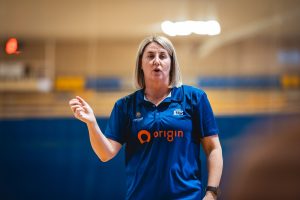
Stacey Marinkovich regularly networks with the SSN clubs and their players. Image courtesy of Netball Australia