


Writers: Jenny Sinclair, Ian Harkin, Georgia Doyle
Photographers: Hannah Howard, Aliesha Vicars
Cover Image: Aliesha Vicars

Diamonds took out a convincing series win against Jamaica. Image: Aliesha Vicars
Talking points
In a Commonwealth Games year, this series was a vital hit out for both nations as they prepare for Glasgow in July.
The Diamonds held a two week camp in the lead up to the series, and one of the overarching themes was pressure – what they can build and apply to other teams. Australia proved to be relentless across the series, upping the ante across the full 60 minutes of each match.
In some of the Diamonds socials, selector Annie Sargeant was spotted working with the shooters, with good impact. You only had to look at the higher-arced shooting style of Sophie Garbin and Cara Koenen, who tend to have a flat shot at times, to see the legend’s influence.
Australia opted to carry the same 12 athletes throughout the series despite traditionally taking 15 athletes through a test series. Head Coach Stacey Marinkovich stated that this was a deliberate choice made in preparation for the Commonwealth Games, where teams are limited to the 12 players who start the tournament.
With injury/illness replacements not allowed during the Commonwealth Games, Marinkovich used three different players across each of the five court positions between goal attack and goal defence. This versatility will give her plenty of options should disaster strike the Australian camp.
However, despite a successful series, Marinkovich was very clear that other athletes may still break into the Commonwealth Games squad depending on their SSN seasons. The biggest question mark probably remains over single position player Sophie Dwyer. Has she done enough to hold her spot, or will Georgie Horjus take over her role, allowing the introduction of another midcourter? At this stage Dwyer is most likely to retain her place, but the ability to have an extra midcourter in such an intense tournament would be a temptation for the selectors.

Shamera Sterling-Humphrey was one of several big names unavailable for Jamaica. Image: Hannah Howard / On The Ball Media
Jamaica were without five of their biggest stars for this series: captain Jhaniele Fowler-Nembhard (due to have a baby in April), Shamera Sterling-Humphrey (yet to return to full play after welcoming her first child in October), Jodi-Ann Ward (rehabbing an ACL injury), Romelda Aiken-George (opted out of the series, recovering from knee surgery) and Shimona Nelson (opted out of the series). In addition, Kadie-Ann Dehaney only spent a total of 25 minutes on court with a niggling injury requiring load management.
Those missing names are some of the biggest and brightest in netball, and any side would struggle to cope with their absence. Jamaica took the opportunity to get some vital game time into their up-and-coming athletes, and while the scorelines weren’t comparative, the experience was vital. What is of greatest concern for Jamaica is that most of their issues were in the midcourt, and yet this is the area of court that won’t have any big names returning for duty. Their bookends are among the best in the world, but without a solid link between them, a Commonwealth Games gold will remain elusive.
Experienced goal attack, Shanice Beckford, took over captaincy duties.

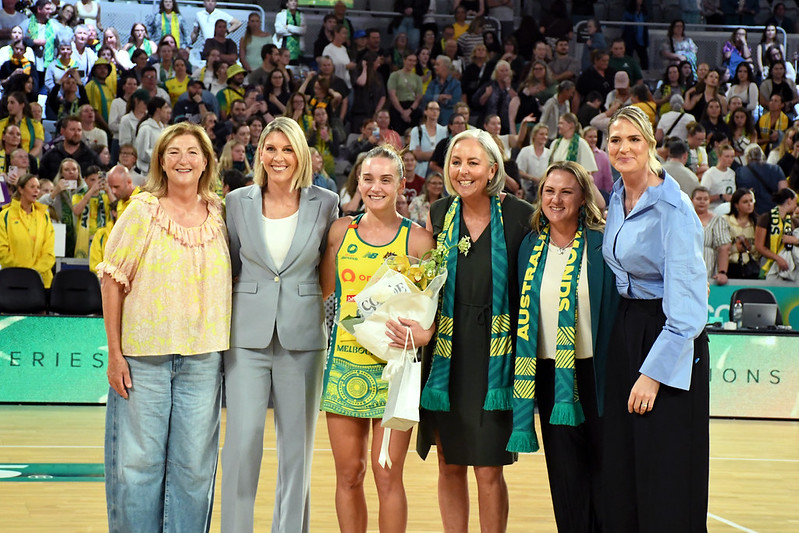
New centurion Liz Watson with her family. Image: Aliesha Vicars
Milestones
Kate Moloney (Aus) – 50 caps in Test 2
Kestina Sturridge (Jam) – Debut in Test 2
Cara Koenen (Aus) – 50 caps in Test 3
Liz Watson (Aus) – 100 caps in Test 3.
Watson is the most capped Australian midcourter of all time, and becomes just the nation’s 6th centurion. She debuted in 2016, and has gone on to win the Liz Ellis Diamond on two occasions, while representing Australia at two Netball World Cups and Commonwealth Games. Watson also took over the Diamonds’ captaincy in 2021.
Injuries
Kadie-Ann Dehaney is being load managed, and didn’t take the court in the first or third test.

Kiera Austin was Player of the Match in Test 1. Image: Hannah Howard / On The Ball Media
First Test – Adelaide
Australia 72 def Jamaica 41 (16-10, 18-12, 20-8, 18-11)
With lots of new faces lining up for Jamaica, it was business as usual to start the first test for the Diamonds. Sophie Garbin made the most of a rare height advantage over a fresh-faced Roxonna McLean, connecting well with Kiera Austin in what we’ve come to expect as a well oiled machine. McLean, however, gained some confidence in the second quarter, and started hunting some balls in the pockets finishing with a solid two gains in just a half of netball.
Her defensive partner, Latanya Wilson, was a clear leader and stand out in the defence end. She was exceptional as usual, finishing with a game high eight gains, that unfortunately couldn’t be capitalised on, with the Sunshine Girls recording just 42% conversion from gained ball.
Shanice Beckford, captaining the side in the absence of Jhaniele Fowler-Nembhard, was back to her best despite needing to shoot at a higher volume than usual. She finished with 17/18 goals, 20 centre pass receives and only two goal assists showing her ability to adapt to the players around her. She was confident to attack the post from range, and vocal when dictating passes both through court and in the shooting circle.
With plenty of rotation from the Diamonds, Cara Koenen appeared back at her best, high scoring with 25 goals from 27 attempts in only 30 minutes of game time. She first combined with Kiera Austin, which caused confusion in the space as Austin is used to a more stationary shooter in Garbin. The entrance of Sophie Dwyer to the game, with her more definite movement opened up Koenen and allowed her to exploit the baseline.
The Australian defenders all finished with a minimum of two gains each, proving that regardless of who is on court they have the ability to shut down opposition and win clean ball. Jo Weston’s injection to the game in the second half, where she finished with four gains and two pick ups proved vital in limiting the impact of Beckford who was the clear leader in Jamaica’s attacking end.
Despite their height, both of Jamaica’s shooters Gezelle Allison and Simone Gordon didn’t play the post up shooter game we are so used to seeing from Jamaica. Often opting to use their footwork to either find space along the base line, or hold a front position and pop forward to the ball. This somewhat limited the Diamonds ability to contest in the air, but the shots from longer range resulted in a shooting accuracy of only 80% throughout the match.

Kate Moloney finished with an amazing seven pickups in test 1. Image: Hannah Howard / On The Ball Media
Second Test – Perth
Australia 73 def Jamaica 41 (20-8, 15-12, 19-13, 19-8)
The Diamonds showcased their versatility with a line that included just one of Test 1’s starting players – Kiera Austin. However, the biggest cheer was reserved for Fever “home-town” athlete, Kadie-Ann Dehaney, who made her only appearance in the series.
One of the highlights of the series was the emerging combination of Georgie Horjus at wing attack and Liz Watson at centre. Watson is such a dominant player through the midcourt, and relished the opportunity to run, compared to her more usual role of wing attack where a few opponents have had success in limiting her workrate in recent years. The speed of ball movement between her and Horjus, and then feeding into the circle, was incredibly slick and proved difficult for Jamaica to quell. In her 47 minutes on court, Horjus finished with 33 feeds and 17 centre pass receives, along with the MVP award.
Australia also tested a range of defensive combinations, and were able to limit Jamaica to just 8 goals in the first and final terms. Courtney Bruce and Jo Weston finished on 3 gains apiece, while midcourters Kiera Austin and Kate Moloney added firepower to the midcourt with 2 each.
For Jamaica, Shanice Beckford and Latanya Wilson were once again standouts for their side. Wilson finished with a game high 7 gains, out of a total of just 9 for Jamaica. Concerningly just four of their athletes were able to pick up loose ball, compared to 8 of the Diamonds contributing.
Gezelle Allison was their best performed shooter, finishing with 16/18 (89%), while Kestina Sturridge was a brief cameo on her debut and finished with 1/1.
Team statistics were of concern to Jamaica, with play often breaking down in the midcourt. They recorded a centre pass conversion rate of just 53%, and converted just 56% of their gains, and 42% of their turnovers to goal. Australia in contrast sat 25-30% higher across all these metrics, which goes a long way to explaining their dominance.

Courtney Bruce and Sarah Klau tried several variations of the lift. Image: Aliesha Vicars
Third Test – Melbourne
Australia 80 def Jamaica 33 (18-6, 17-12, 24-10, 21-5)
Coach Stacey Marinkovich started the third test with yet another lineup, and rang the changes across the match in a relatively seamless exchange of combinations. In the first half, Cara Koenen was back to her brilliant best, working the baseline and making the most of a height mismatch against Roxonna McLean. It was Sophie Dwyer’s first start against the dangerous Latty Wilson, and she played it smartly, hanging out of the circle to allow Koenen the freedom to work her magic. Dwyer also contributed an ice-cold 12 goals at 100% accuracy.
At the opposite end, Simone Gordon was monstered by Courtney Bruce, and after attempting and missing just one shot, was replaced by Gezelle Allison half way through the first quarter. With new faces around her, captain and goal attack Shanice Beckford had to work overtime in attack, which impacted her availability and accuracy at the post.
Australia shone even brighter in the second half, with Kate Moloney particularly impressive at wing defence with 3 intercepts. Captain and new centurion Liz Watson played a standout role at centre, and the blistering speed of her combination with wing attack Georgie Horjus left the Sunshine Girls with few answers. The final term proved to be somewhat of a bloodbath, with Jamaica scoring just five goals as time and again the Diamonds picked off ball across the transverse line.

Captain Liz Watson took out MVP in the third test, and capped it off with Player of the Series. Image: Aliesha Vicars
Key Statistics
There was a substantial gap between the two teams when it came to converting attacking opportunities.
The Diamonds’ efficiency with ball in hand improved significantly over the course of the series. In test one, they finished with 24 general play turnovers and converted 76% of their centre passes. In test two, those numbers improved to 15 turnovers and an 81% centre pass to goal rate. Then in the final test, it all fell into place – just 11 turnovers and a centre pass to goal rate of 88%. Those numbers are just short of the outstanding performance from Test one of last year’s Constellation Cup. The Diamonds’ improvement throughout the series was also shown in their gain to goal rate; from 71%, to 80%, to an incredible 93% in the third test.
Sadly, for Jamaica, it was a different story. They put in their poorest performance in the final test of the series. Already struggling with a centre pass to goal rate of 52% & 53% in the first two matches, that dropped to just 45% in test three. Over the course of the series, they converted just less than half of the total possessions they had.
Series Stats:
Goals from centre passes:
AUS 141/173 (82%)
JAM 87/174 (50%)
Goals from gains:
AUS 45/56 (80%)
JAM 14/31 (45%)
Goals from turnovers:
AUS 39/57 (68%)
JAM 14/27 (52%)
Total goals per possession:
AUS 225/286 (78.7%)
JAM 115/232 (49.6%)

Australia’s defence smothered Jamaica’s forays into attack. Image: Aliesha Vicars
Strengths – Australia
As previously mentioned, once the Commonwealth Games starts, injured or ill athletes can’t be replaced. To combat this possibility, squad versatility is a must. Players should mostly be able to play a range of positions, in different combinations, and fit seamlessly together if needed.
While the Sunshine Girls weren’t at full strength, the Diamonds were able to test a wide range of combinations. For each of the five positions between goal attack and goal defence, they used three different options, hopefully allowing for plenty of cover if disaster strikes.
What would have been incredibly pleasing for Stacey Marinkovich was the seamless nature in which each of the combinations attacked their court time together. With each athlete fighting for a starting seven position and court time, they left nothing in the tank, even if they were just on court for 30 minutes. Players were rotated on and off, generally at half and three quarter time, with the Diamonds recording their biggest margins in the second half of each game.
While part of this could be due to the Sunshine Girls tiring and their error rate increasing, it was also a credit to those Diamonds who came on as impact players after half time.
New combinations can come with increased turnovers, and this was the case in the first match, where the Diamonds recorded 24. Too high for their usual standards, they pleasingly brought the error rate down to 15 in the second test, and just 11 in the third.
The added advantage of such versatility is the increased difficulty factor for nations preparing to face Australia, and being unsure of what combinations they will face.

Georgie Horjus was part of a versatile Diamonds team. Image: Hannah Howard / On The Ball Media
Strengths – Jamaica
Despite the large margins against them, several Sunshine Girls gained much-needed experience in this series. It’s experience that will hold them in good stead when it comes time for the Commonwealth Games. The Jamaican team can’t only depend on their superstars for success, and need the next tier of players to be able to step up when required. Although the scorelines in the three tests were disappointing, any lessons these players can take from this series, and also the recent tests against England, will be valuable.
It goes without saying that Latanya Wilson was a dominant player for Jamaica in this series. Her numbers were astonishing; 23 gains, 13 intercepts, 15 deflections, and 7 rebounds. With Kadie-Ann Dehaney’s fitness being managed, it was left to Roxonna McLean to back up Wilson in the circle for most of the three tests, and she showed promise in her time on court.

Latanya Wilson was at her brilliant best in the series. Image: Hannah Howard / On The Ball Media
Challenges – Australia
While Australia recorded three convincing wins, if we had to be picky, their biggest challenge is still a “get out of jail free” card, aka a tall post shooter in the mould of Jhaniele Fowler-Nembhard or Grace Nweke. Their fortunate nations, if lacking options in attack, can generally lob up a high ball and know it will land in safe hands. It makes the passage to goal much quicker, saving legs and reducing the risk of having the ball intercepted.
To combat this, Australia have developed insane levels of fitness, allowing them to do the extra work to move the ball closer to the circle before sending it in. They also have variety. While she stands at just 184cm, Sophie Garbin has a strong hold and a terrific vertical jump. In contrast, Cara Koenen offers strong movement, particularly along the baseline and as a second phase option.
Australia’s transition to a far more mobile circle has proved effective for them at recent pinnacle events, but in a tight match, this lack of a post shooter could prove to be a challenge.
Donnell Wallam, who would provide this option, remains a small chance of breaking into the Commonwealth Games team. However, a cruel run of injuries and illnesses prior to camps or test matches has limited her ability to gain court time. With pinnacle event newcomers Georgie Horjus, Tilly Garrett and Sophie Dwyer likely to take their place in the team, it’s unlikely the Diamonds will take a chance on yet another player with such limited experience.
Australia’s other area that could be an issue is a lack of height and stopping power in their midcourt. While they can generally be relied on to pick up loose balls, the midcourt aren’t known for coming up with many intercepts, particularly in contrast to New Zealand. The ability to stop the ball before it gets to the circle is one of the keys to the modern game, and to help combat this, Australia has been working over time on its centre pass defence, in the hope of forcing some feeding errors.

Sophie Dwyer was ice cold under the post in the third test. Image: Aliesha Vicars
Challenges – Jamaica
Jamaica was missing a lot of big name experience in this series, and it showed, particularly in the attacking midcourt. The connections just weren’t there and confidence was lacking. They ended the series with 98 general play turnovers and just 77% shooting, as compared to Australia’s 50 turnovers and 89% accuracy.
With so many turnovers, a big problem was conceding goals in clumps. The series started with Australia scoring six goals before Jamaica could get on the board. Then in the second quarter, just as it looked like Jamaica could challenge, Australia piled on nine straight goals to stretch the lead once again. That was a recurring theme in the following two tests, and it was exemplified by the finish to the series as the Diamonds scored the final 10 goals of the third test in Melbourne.
While it is terrific to see Jamaican players getting opportunities in other parts of the world, particularly in Super Netball, it does make things difficult for the Sunshine Girls to get together regularly as a full squad and prepare. This is going to be a problem for the team leading up to Glasgow.

Cara Koenen’s confidence returned in this series. Image: Hannah Howard / On The Ball Media
Players that caught our eye
After a rocky international season last year, Cara Koenen is back to her elusive best. Having put the work in with a sports psychologist in recent months, Koenen looked far more confident on court and going to the post. The third test was her best, as Koenen showcased her ability to run the baseline, and be available for second phase. Koenen finished her 30 minutes with 23/25 (92%), two rebounds, and seven second-phase receives.
Georgie Horjus came of age in the Jamaican series, with three blistering performances. A relative newcomer to the Diamonds, her creativity, speed and quick ball movement has seen Horjus cement her place in the 12. She was mainly used at wing attack, but in the final quarter of test three, Horjus swapped positions with Kiera Austin, and slotted into goal attack nicely.
Liz Watson has been the world’s dominant wing attack for most of her 100 test caps. However, in this series she was an absolute standout at centre. Australia is blessed with a range of options in that position, including Jamie-Lee Price and Kate Moloney, but Watson’s combination with Horjus at wing attack showcased their speed of ball movement and strength, and an understanding that belies the relatively short period of time they have worked together.
In a Jamaican team missing a number of stars, the brilliance of Latanya Wilson stood out even more than usual. She was a constant menace to the Diamonds’ attack line, finishing with an incredible total of 23 of the 31 possession gains that Jamaica had during the series. The possible addition of Shamera Sterling-Humphrey, Jodi-Ann Ward, and a fully fit Kadie-Ann Dehaney for the Commonwealth Games is a daunting prospect for other nations.
With Jamaica missing three big name goal shooters, it was thought they would struggle in that position. And they certainly had their battles in the circle. But given that she was playing in a beaten side, Gizelle Allison made the most of her opportunities, standing up to the solid defence of the Diamonds.

Gezelle Allison had big shoes to fill at goal shooter. Image: Hannah Howard / On The Ball Media

After match huddle. Image: Hannah Howard / On The Ball Media
Stay in the conversation with the Netball Scoop forum.
Catchup on all the netball news before Suncorp Super Netball resumes with the Netball Scoop podcast. Available on Spotify and Youtube.