


Writers: Jenny Sinclair, Ian Harkin, Andrew Kennedy
Photographers: Aliesha Vicars, May Bailey, Tash Rudd
Cover Image: Aliesha Vicars
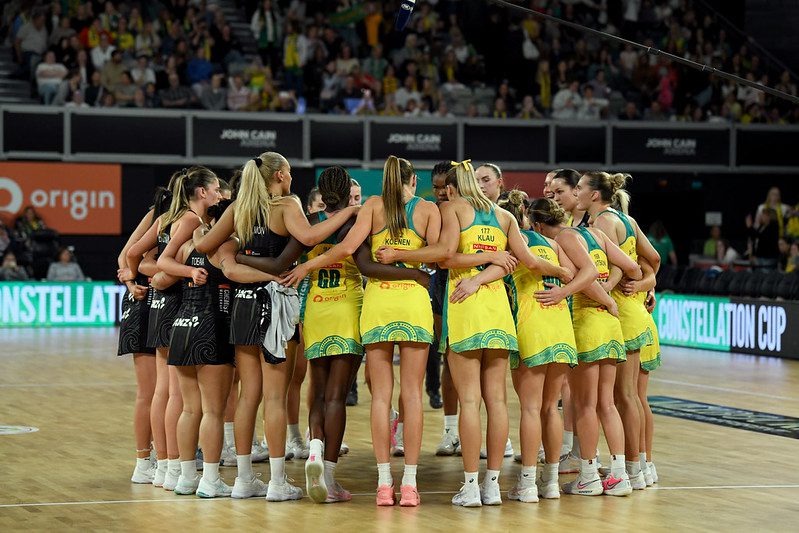
After the most tumultuous ever period in Silver Ferns history, no one knew which side would turn up to the Constellation Cup – one united and galvanised by their woes, or one that struggled out on court. Unfortunately for New Zealand, it was the second that took the court in the first test match. While they stuck with Australia for most of the first three quarters, the match unravelled in the last term, with mental fatigue, a raft of changes, and challenges across the goal and wing attack positions all contributing factors.
And it was a similar story in the second test. Again, it was one quarter which really blew the margin out of the water. After an encouraging second quarter which had the Silver Ferns trailing by just two at the main break, it all went horribly wrong for New Zealand in the third quarter, losing it 20-9 and putting the result basically beyond doubt. The Silver Ferns will need to regroup quickly ahead of game three. The Diamonds now take a 2-0 lead as they head to New Zealand, a place where they haven’t won for four years.

The New Zealand defence had few answers to Australia’s speed and angles. Image: Aliesha Vicars.
—
MILESTONES
In Test one, Sophie Garbin notched up 1000 international goals, while Kiera Austin went past the 500 goal mark.
In Test two, Liz Watson played her 50th test match as captain. Watson is also the Diamonds’ most capped midcourter, and has moved into 6th as the most capped Australian of all time.
After these two wins, Stacey Marinkovich has achieved the 5th most victories of any Diamonds’ coach.

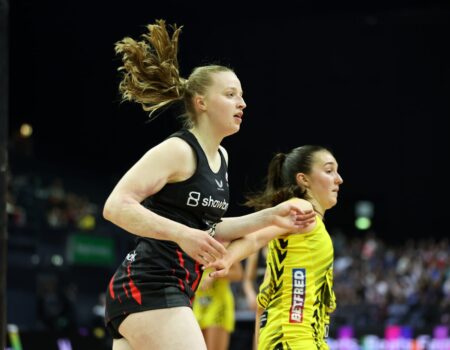
Sophie Garbin and Karin Burger contest for the ball. Image: May Bailey-Ireland/Clusterpix
—
Test 1 – Melbourne
Australia 69 def New Zealand 52 (13-13, 17-15, 15-13, 24-11)
AUS 69/77 (90%)
Garbin 42/45 (93%), Austin 27/32 (84%)
NZ 52/60 (87%)
Nweke 37/41 (90%), Salmon 12/15 (80%), Walmsley 3/4 (75%)
The Diamonds ran out comfortable winners in game one of the series. The match started in frantic fashion with numerous changes of possession in a defence-dominated first quarter. New Zealand had six general play turnovers and Australia five. But from that point on, the Australian team found their rhythm and were very clinical in attack. They only had four more turnovers for the rest of the game. They were patient with the ball, calmly waiting for an opening, and using short, sharp passes to limit the effectiveness of the New Zealand defence.
Sophie Garbin had one of her best games for the Diamonds and as the match wore on, the feeders had trust in her to take the ball, despite the attention she was receiving. The Silver Ferns battled strongly to stay in touch, but unfortunately, their game fell apart in the last quarter. There were numerous changes made by Yvette McCausland-Durie, but to no avail. By contrast, everything fell into place for the Diamonds as they played a near faultless final 15 minutes, converting 24 of a possible 25 scoring opportunities. For Australia, Kate Moloney was everywhere, racking up 22 assists for the match without a single turnover. She was judged Player of the Match.
Moloney teamed up perfectly with fellow Vixens, Garbin and Kiera Austin. Garbin was incredibly strong under the post, absorbing all of the pressure while Austin improved steadily as the match went on. They got the better of the Silver Ferns’ defensive duo, Kelly Jackson and Karin Burger. Burger was on fire in the first half but her influence waned, while Jackson was heavily penalised.
At the other end of the court, Courtney Bruce set the tone early in her battle with Grace Nweke, grabbing four gains in the first quarter. Nweke did the best she could despite some below par feeds at times. Thanks to the smothering defence of Moloney, Jamie-Lee Price and Sunday Aryang, the Ferns struggled to find a path to goal, resulting in several wayward passes being thrown in hope.
Player of the Match: Kate Moloney (Australia)

Kate Moloney was a well deserved MVP for Test 1. Image: Aliesha Vicars.
—
Test 2 – Sydney
Australia 68 def New Zealand 51 (19-13, 11-15, 21-9, 17-14)
AUS 68/85 (80%)
Garbin 33/39 (85%), Horjus 13/19 68%, Austin 11/12 (92%), Koenen 11/15 (73%)
NZ 51/58 (88%)
Nweke 37/43 (86%), Heffernan 10/11 (91%), Salmon 4/4 (100%)
The Diamonds took a 2-0 lead in the series, with a commanding 17-goal win in the second test. With both starting sevens unchanged from test one, Australia played a smart and measured first quarter, manipulating the Kiwi defence by drawing players away with relative ease and taking advantage of the ample spaces opened up. The home side were able to use good ball placement without needing the lightning speed of the first test, and the visitors acquired zero gains in the first stanza. When the Diamonds front line could find and hold off a body, the New Zealanders struggled to get around to challenge a pass. Sophie Garbin had another strong game.
Georgia Heffernan brought an early spark for the Silver Ferns in the second quarter, dominating the circle periphery and middle channel, and neatly slotting her first four goals. The New Zealand defence’s eyes were up and their swarming tactics more aggressive, cutting off Australian drives and creating more doubt. Both midcourts were trapping their opposition into penalties, firing up the Kiwis who peppered feeds with great length into Grace Nweke, building the team’s confidence. Kelly Jackson came up with three crucial gains as the Ferns narrowed the gap to just two at half time.
The introduction of Georgie Horjus at goal attack to start the second half kicked off a party for Diamonds supporters, as the Thunderbirds hero brought the whole front end a new lease of life. It was Australia’s best quarter, and tellingly, despite seven missed shots from Australia, the Silver Ferns did not get a single defensive rebound. At the other end, the New Zealand attack were struggling to even take a pass securely under heavy pressure from Sunday Aryang and Courtney Bruce.
All the while, Liz Watson was having a tremendous captain’s game, not just in attack, but also coming up with inspirational plays in defence. She and fellow midcourter Jamie-Lee Price finished with an Australian high 3 gains each.
Several changes were made for the final quarter, but the damage had been done in the third, and the Diamonds ran out big winners. Australia had just 10 general play turnovers for the match, continuing their efficiency from the first test.
Player of the Match: Liz Watson (Australia)

Liz Watson won MVP in her 50th match as Australian captain. Image: May Bailey-Ireland/Clusterpix
—
STRENGTHS
Diamonds
It sounds simplistic, but one of the major strengths of the Diamonds in these two tests has just been their teamwork. Every player in the team has been clear on their role, and if a player ebbed, another always stepped up. Coach Stacey Marinkovich has resisted the temptation to make bulk changes, allowing players to settle into the game, and she’s been rewarded by her players on both occasions. In the first test, it was Sophie Garbin and Kate Moloney who rose to the challenge, and in the second test, Liz Watson who had been quiet in game one, had an incredible match.
The Diamonds have been remarkably tidy in these two tests. Nine general play turnovers was a tremendous performance in test one, and just to prove that was no fluke, they had just one more in the second test. They have been successful in keeping the New Zealand defence out of the game, and with that, not allowing the Silver Ferns to grow in confidence. The Diamonds have been very patient, with risky cross-court passes almost non-existent.
Australia would also be pleased that they improved their ability to win ball across the two matches. In Test 1, they finished with just 6 gains, but doubled that total to 12 in Test 2. Pleasingly, seven team members contributed to that, with the midcourt leading the way. Jamie-Lee Price and Watson were inspirational, each finishing with three.
Price plays the majority of her Super Netball at centre, but right at this moment in time, she is perfect for Australia at wing defence. The stats say that in the first test, she had zero gains, but of course that doesn’t begin to tell the story. Her pressure at the centre pass and second phase was immense, and she was often successful in cutting off the avenue to goal and making the Silver Ferns adjust and choose a riskier option. In the second test, she was once again one of the best on court.

Jamie Lee-Price has had an exception two games, challenging Mila Reuelu-Buchanan at wing attack. Image: May Bailey-Ireland/Clusterpix
Silver Ferns
The positives are few and far between for the Silver Ferns at the moment, as they look disjointed and out of sorts. With goal attack Ameliaranne Ekenasio having a break from elite netball and little depth below her, they’ve been forced to trial a number of rookies, with Georgia Heffernan, Martina Salmon and Amelia Walmsley all given court time.
Salmon was the preferred option against South Africa, and with her height and accuracy will be a weapon once she hones her game. She’s likely to get the opportunity to do that in 2026, as she teams up with Walmsley domestically. However, she did struggle as an option against Australia – while her shooting was accurate, she lacked the drive or ability to draw the defence to be a different option than Nweke. This should come with court time.
Heffernan finally got her chance to shine in Test 2, and her form was encouraging. She was another attacking option when the wing attack was covered, and finished with 10/11, 14 centre pass receives and 15 feeds in 40 minutes. While her 4 turnovers was the highest on court, match day experience against such tough opposition will stand her in good stead.
Grace Nweke was the only Silver Fern given an opportunity under the post, and heaven help New Zealand if they should lose her to injury as happened in the last World Cup. While her accuracy wavered across both tests, and she was put under enormous pressure by some substandard feeding at times, her athleticism and ability to pull the ball out of the air makes her a massive target at goal shooter. While it might mean some short term pain, the Silver Ferns should perhaps look at developing a viable alternative. Both Walmsley and Salmon have shown the potential to be genuine threats to any opponent, but do need experience against Australia.

Martina Salmon grew up in Australian pathways but is now playing for the Silver Ferns, and could be a long term option for them at goal attack. Image: Aliesha Vicars.
—
CHALLENGES
Diamonds
Moving towards the 2026 Commonwealth Games, this international season is answering some questions, but raising others – most notably in the midcourt for Australia. Wing attack Alice Teague-Neeld was voted Player of the Series against South Africa, but she’s not playing in this series. Wing defence Amy Parmenter was chosen ahead of her, but based on the first two tests, Jamie-Lee Price has the wing defence position well and truly sewn up at the moment. Parmenter is one of a few players who, thanks to the Diamonds’ good form, haven’t had much game time in the first two tests. They will need to be ready if called upon in the New Zealand leg of the series.
Is Georgie Horjus a wing attack or goal attack? Just as she was against South Africa, she was a breath of fresh air when she got on court for the second half of test two, providing a great spark in the attack end. But this was the first occasion that she has played in the circle against the New Zealand defence. And it certainly caused some problems for her shooting accuracy. In the third quarter, she shot at just 58%.
Horjus was able to improve that by the end of the match to 68%, but that is still not great. She wasn’t an orphan however, with Australia shooting at a lowly 80% in the second test. Surprisingly, the New Zealand defence wasn’t able to pounce on these misses, but they surely will in future.
The Diamonds will also look to build consistency, putting their foot on the throat of any opponent across all four quarters of the match. So far, that’s been a miss across the Australian leg of the series. In Test 1, they were just level pegging after the first quarter, while in Test 2, they dropped the second quarter by two goals. It could be argued that the Silver Ferns were at their best early in the game, but Australia had opportunities to build leads and squandered them: across each of those quarters, the Diamonds gave away five turnovers, half of their total for each game.

Georgie Horjus’ accuracy was down on her usual standards, but her speed and court craft was a highlight. Image: May Bailey-Ireland/Clusterpix
Silver Ferns
New Zealand’s biggest challenge will be off court – uniting what looks to be a fractured and dispirited team.
On court, the Silver Ferns have largely settled on five of their starting seven, but it was at wing attack and goal attack that their struggles were apparent.
Their three goal attack options lack experience, and with Australian wing defence Jamie-Lee Price in blistering form, each of the three wing attacks used against her also had their struggles. Half of the Silver Ferns centre passes had to go via the back door of wing defence/goal defence in the first test, as the combination of Sunday Aryang, Kate Moloney and Price reduced options across the attacking transverse line. Feeding was less of an issue, with Nweke able to pull in most balls, but Australia pounced on anything that was remotely loose. This was summed up by a superb effort in Test 1 when pressure over the shot led to a ball fed out of the circle, tipped by Moloney to Price, who tapped it onto Aryang to pass down court.
Normally a great strength, the Silver Ferns defenders have struggled for gains. They took just 7 in the first test and 6 in the second, with defensive rebounds a particular issue. In the third quarter of test two they embarrassingly took no rebounds despite seven misses from the much shorter Garbin and Horjus.
For a side that normally prides itself on keeping the umpire’s whistle out of the game, the Silver Ferns have had increasing numbers of penalties in the last couple of seasons, and this was true for both the test matches. In match 1, they had 69 to Australia’s 56, while in the second match, they had 71 to Australia’s 52. More concerningly, their circle defenders gave away an expensive 27 obstructions across the matches. It released pressure on the Australian shooters, and yet is a relatively easy fix. If Jackson – the main offender – can stay in play, her long arms create accuracy nightmares for her opponents.

Grace Nweke continues to show her support for stood down coach Dame Noeline Taurua. Image: May Bailey-Ireland/Clusterpix
—-
Key Stats
As you would expect with two big wins, the key numbers are all one way. In the first test, the Diamonds recorded their highest ever score (69), and highest scoring quarter (24) against the Silver Ferns. In that game, Australia finished with a centre pass to goal rate of 89%. Anything above 80% is very good, but 89% is extraordinary. On to test two, and the story was very similar. This time, the Diamonds scored 68 goals, and had a 20-goal third quarter. And once again, their centre pass to goal rate was above 80%. Not quite at first test levels, but 82% is still a winning number in most matches.
After two tests:
Shooting: AUS 137/162 (85%) v NZ 103/118 (87%)
Assists: AUS 120 (Watson 39) v NZ 90 (Reuelu-Buchanan 21)
Rebounds: AUS 18 (Garbin 9) v NZ 15 (Nweke 9)
Gains: AUS 18 (Bruce 6) v NZ 12 (Burger 6)
Intercepts: AUS 11 (Price, Watson, Bruce 3) v NZ 6 (Burger 3)
Penalties: AUS 108 (Bruce 30) v NZ 140 (Burger 34)
Turnovers: AUS 19 (Austin 7) v NZ 36 (Gordon 7)

Sunday Aryang picked Martina Salmon’s pocket nicely. Image: Aliesha Vicars.