


The 800m runner talks about big life changes, injury recovery and finally being able to process being thrust into the Olympic spotlight at such a young age.
At 5ft 10in tall, Phoebe Gill cuts a striking figure as she enters the small Edinburgh café. The 18-year-old Olympic semi-finalist orders a coffee, the woman behind the counter oblivious to the accolades that have at times weighed heavy on this teenager’s shoulders.
Taking a seat, Gill momentarily blends into her university surroundings, but she is no average student. As the 2026 outdoor season approaches, this young athlete – a national age-group record-holder who has already gained a lifetime of experiences – will once again negotiate the world of track and field and the contrasting emotions of nervousness and excitement that come with it.
“My main fear right now is of the unknown and where I’m at fitness level-wise,” she says. “I just want to get one race under my belt to show where I’m at and what we have to do.”
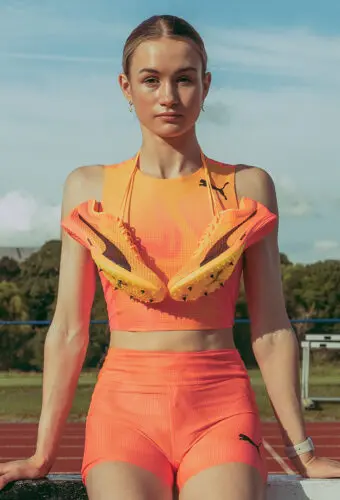
Gill’s already eventful career to date has been well documented. In 2022 she won the English Schools 800m title and backed that up with victory and a then personal best of 2:03.34 at the SIAB Schools International. The 2023 English Schools 800m title followed and, later that summer, gold at the Commonwealth Youth Games in Trinidad and Tobago. She ended her season by lowering that personal best to 2:01.50 at the British Milers Club meeting in Watford.
In 2024, her profile grew exponentially when she ran a European U18 record of 1:57.86 to win the early season Belfast Irish Milers Meet, backed that up with victory in the UK Championships (1:58.66) and was deservedly selected to represent Team GB at the Olympic Games in Paris – Britain’s youngest track and field Olympian for more than 40 years – where she reached the semi-finals.
The St Alban’s athlete has raced only once since then – a 53.65 400m at the London Indoor Games at Lee Valley in January of last year. She has also endured two back-to-back stress fractures, sat her A-level exams and, in September 2025, relocated to the Scottish capital as the first major signing for the University of Edinburgh’s ambitious Global Endurance Project led by 1988 Olympic 3000m steeplechase bronze medallist Mark Rowland, a renowned coach who previously headed up Nike’s Oregon Track Club Elite.
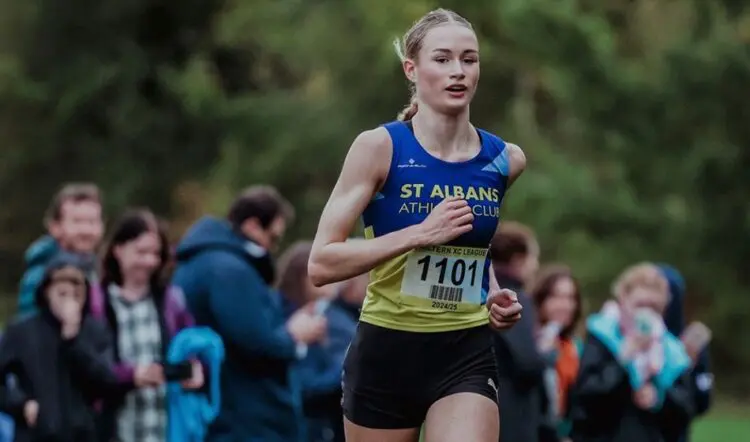
After such a lengthy period on the sidelines – albeit one that has run in parallel with a positive move north of the border – Gill now has a solid winter of training behind her. Having made a conscious decision to miss the indoor season, she is looking ahead to the summer with a fresh perspective.
“I definitely feel like a new athlete,” she says. “I think that being injured teaches you a lot about your body and how you can respond to challenges. It’s really motivated me to engage with psychology and talk to people about how I’m feeling, because I’d never really had an injury before.
“Unless you’re an athlete, I don’t think you really understand how damaging it is to go through an injury and to have something that you love so much be taken away. It just completely disrupts how you live your life. I’m in this for the long game so the likelihood is I will get injured again; I just want to try and prevent that from happening this year.”
The university set-up has benefited Gill beyond the coaching expertise of Rowland and the support of her training group. Being catapulted on to the Olympic stage at the age of 17 and the trauma of a subsequent stress fracture (“It was a lot to deal with,” she says of the injury) have left their mark, but working with a sports psychologist has helped her process those extreme experiences and prepare her mentally for a return to racing.
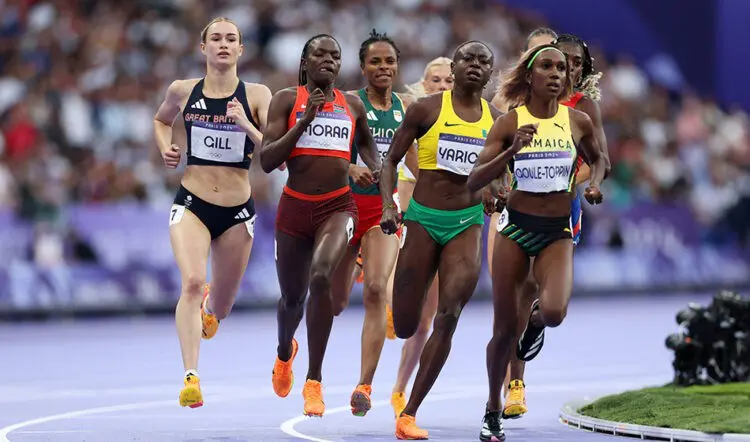
“It’s funny, because I was actually speaking to my sports psychologist about this the other day, about how I don’t really feel like I’ve properly decompressed after the whole Paris journey,” she says. “I went from such an extreme high in the sport to a couple of months later not running at all, and that shift in my life balance was such a weird change and something I’d never really experienced before,.
“It also came in the same year as I had my A-levels, so I never really processed that properly. It’s only now that I’ve come to uni and I’ve finally settled that I think everything is actually starting to hit me. I’ve been able to speak to the sports psychologist here and just go through the journey and the emotions and take myself back to that place and try to actually process everything that happened, because it was quite a lot for a 17-year-old to go through at the time. I think I’m only just starting to realise that now.”
Gill’s return to physical fitness has brought its own challenges. There is an urge to play it safe, the complete antithesis to the internal voice that had urged her to train more and harder as she built towards Paris and then onwards to the indoor season. “I probably trained a bit too hard…I used to hammer every session,” she admits.
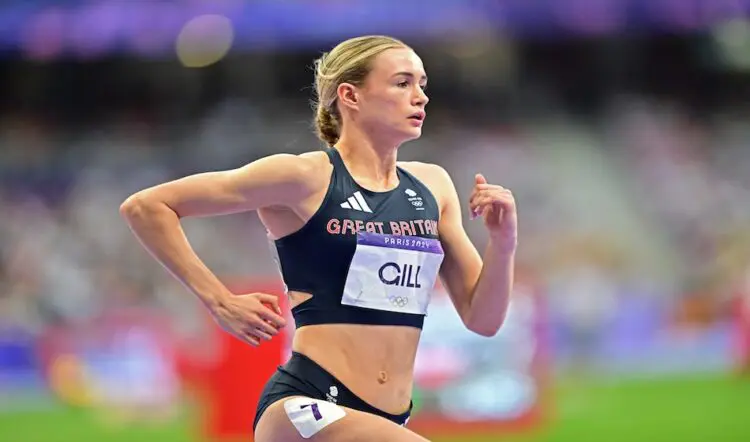
Naturally, she’s scared of that happening again. “Right now I just want to protect myself and be ready for the summer season. I just want to get back racing, but I want to do it right and not risk anything in the process.”
She has learned so much and continues to do so. On the track and in the gym – together with Rowland who is also working closely with her physiotherapist and the strength and conditioning team – she has committed to making herself biomechanically robust to ensure longevity in the sport rather than for short-term gain. There are more drills sessions, a greater focus on mileage and threshold runs (heart rate zones and rate of perceived exertion over eyeballs out), and two weights sessions per week.
A former swimmer, Gill is also incorporating sessions in the pool into her double-threshold days while her mileage continues to build gradually. The next step is speedwork. “I can’t wait,” she laughs. “I’m really eager to get going because I haven’t done speed in so long.”
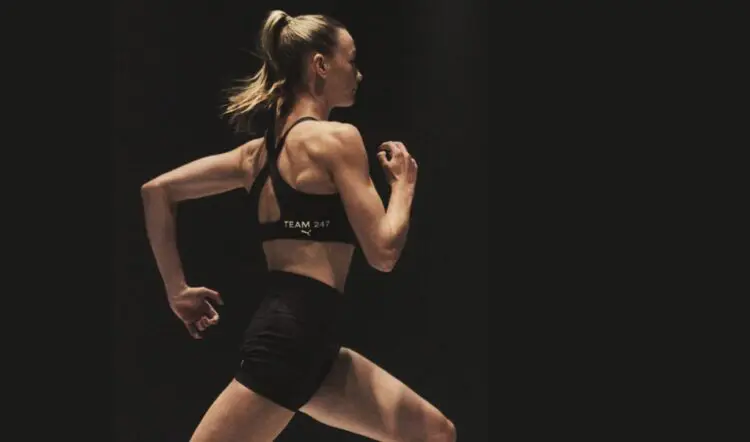
Off the track she’s in the process of switching her degree from sport science to biomedical sciences, a smart decision driven by her need to separate sport from academics. As summer beckons, competition plans are beginning to form. The Commonwealth Games at the end of July was initially a target and she’s talked at length with Rowland and club coach Deborah Steer about whether or not it should remain a focus alongside the World U20 Championships at the beginning of August.
Steer knows her better than anyone; she began coaching Gill when she was 10 years old, they went through the Olympic journey together, and she is, says the athlete: “The reason I love this sport”. Coupled with Rowland’s ambition, the coaching duo have developed a positive working relationship with communication dedicated to managing Gill’s talent and maximising her potential.
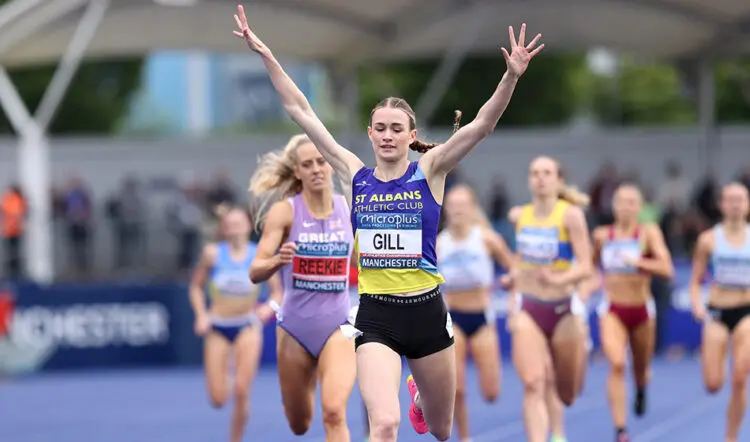
Regardless, the reality is that in a summer during which the Commonwealth Games (Glasgow), World U20 Championships (Oregon) and European Championships (Birmingham) take place within a month, she can’t do everything.
“Obviously it would be amazing to do the Commonwealth Games, especially in Glasgow, but I’ve never done an age-group championship so we’re actually leaning towards the World U20s and just trying to get a medal there,” says Gill.
She recalls advice she was given by Olympic 800m champion Keely Hodgkinson when she was 16: “She said to stick with the age groups, and I think I’ve only just started to realise how important that is. Obviously now I’ve been to the Olympics, but you get so much experience going to these age group events. I think the only international race I’d done before the Olympics was the Youth Commonwealth Games and that gave me a real taste of what it was like to be on an international team. I was so grateful for that experience going into Paris because, if I hadn’t had that, I wouldn’t have had anything.”
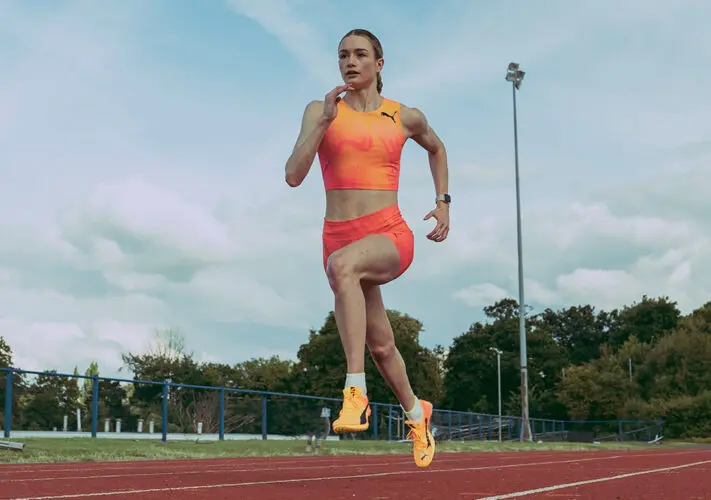
Paris, of course, changed everything, and when the time comes to toe the line once again she’ll do so as “Phoebe Gill version two”, a young athlete who has re-built herself physically and mentally in a bid to succeed in the sport over the long-term.
First up is her maiden altitude training camp, in Font Romeu. She then hopes to return to racing quietly, admitting that while the media attention of 2024 was “nice to an extent”, it also brought pressure.
“I feel like I’m going back into running as an underdog again, which was obviously taken away from me after I ran 1:57,” she says. “I was kind of put in the limelight a bit, but now there’s less pressure, I’m putting less pressure on myself, and I can just enjoy racing again.
“I’m actually really grateful that it all happened, because I’ve now got experiences that most 17-year-olds don’t have and I feel like that gives me a tiny bit of an edge maturity-wise; I now know what to expect at senior level championships, so I can just take a step back and focus on the age group champs and use what I’ve learned.
“I’m definitely nervous about racing again, I think about it all the time, but that just shows how passionate I am about the sport and how much I care about running; it means so much to me and it’s given me so much in life.
“On the flipside, I’m still only 18 and I want to be in this for the long game, so if this year doesn’t match what I produced when I was 17 then I won’t mind too much because hopefully I’ve got a decade or more still in me. There will be other chances, but this year is about coming back, seeing what I can produce, and trying to stay healthy.”


