




The 16-year-old New Zealand athlete and his father Ben talk at length about making history, managing expectations, sibling rivalry, following in the family tradition and maintaining a healthy perspective.
He might only be 16 years old, but Sam Ruthe certainly isn’t ignorant to one of the great truths of elite athletics – especially when a young talent is concerned. “With running fast definitely comes more pressure,” admits the New Zealander. There is plenty of that, and no little attention, surrounding this young man whenever he runs – and with good reason. His performances are making the sport sit up and take notice.
Breaking records is becoming second nature – and an extremely regular occurrence.
Almost a year has passed since he became the youngest person in history to run a sub-four-minute mile, clocking 3:58.33 in wet conditions at Auckland’s Mount Smart Stadium. By that point he had already broken a number of records and become New Zealand’s youngest senior national champion – he won the 3000m in an age-group world record of 7:56.18 – but this was different. Not only did he clear that fabled four-minute barrier aged just 15 years and 341 days but the person he took the record from, at 16 and 350 days, was a certain Jakob Ingebrigtsen.
There is a danger that such a breakthrough could be overwhelming for such a young athlete and, with the media attention that comes with it, even a prodigiously talented one could be unnerved by the increasing intensity of the spotlight. However, with the support of an understanding, knowledgeable and tight-knit network, Ruthe has used that performance as a launchpad.
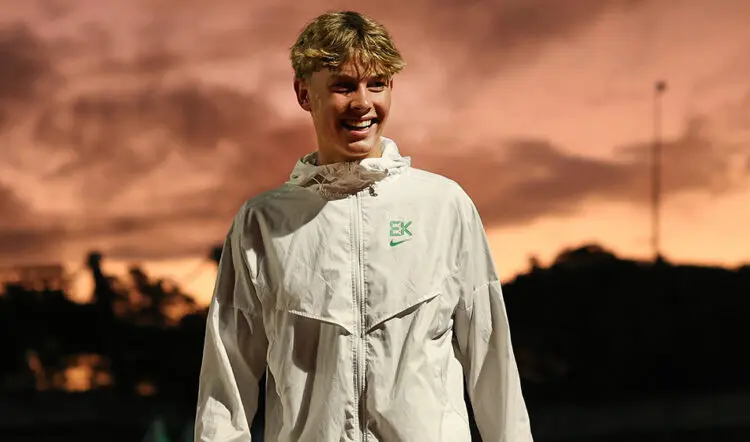
Fast forward to this winter and over the past few months he has continued to remove chunks from age-group records. In December he set an Oceania under-18 5000m mark of 13:40.48, before becoming the fastest 16-year-old over 1000m with 2:17.82 on January 3.
An Oceania under-18 800m mark of 1:45.86 followed on January 17 and, one week later, he ran a 3:53.83 mile in Whanganui, breaking Cameron Myers’ age-16 world record of 3:55.84.
It was then that he, father Ben and training partner Sam Tanner headed for the East Coast of America and what has proved to be an eventful and educational trip, beginning with a first taste of a US indoor meeting at Boston University on January 31.
On the fast track, Ruthe decimated his personal best in the mile and won the race in 3:48.88, lowering his age-group world record and breaking John Walker’s national senior mark of 3:49.08 – set outdoors – from 1982 into the bargain.
More was to come on February 22 at the same venue, with the final race of the “American tour” producing a run over 3000m of 7:43.16 that represented the missing piece of a record-breaking jigsaw and means Ruthe now holds every New Zealand mark from 800m to 5000m across the U17 to U20 age groups.
With a professional contract with Nike signed last year and a growing Instagram following, his wider profile is only going in one direction. Yet, having achieved times that most senior athletes would dream of, the person in the middle of it all seems to be taking everything in his stride so far.
“I enjoy running for what it is, so the pressure doesn’t really bother me,” he says. “Winning a mile in 3:48 does put a lot more pressure on me but my mindset is that, whenever I’m in a field, I need to be ready to race and perform to the best of my ability.”
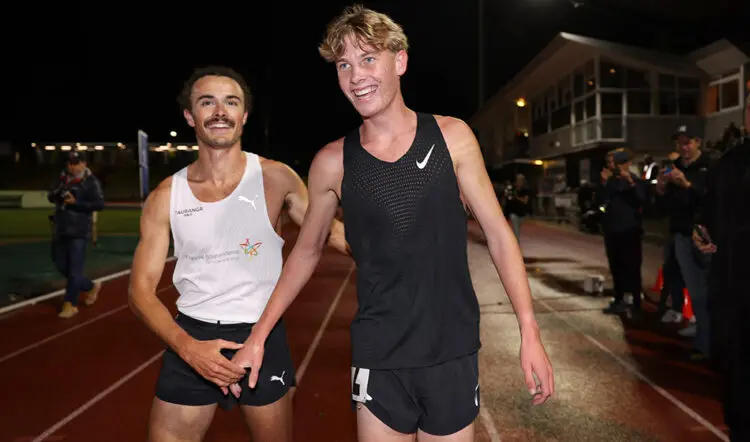
Sam and Ben are talking to AW from the US as they continue to navigate their way through uncharted waters. Throughout the conversation, the importance of fun, enjoyment and simplicity is a recurring theme, as is a desire to walk towards challenges rather than shy away from them. Part of the reason for Sam spending time in America was to experience top level athletics outside of New Zealand and to learn – a task that he has fully embraced.
“I mean, it’s a different experience than anything you’ll find back at home,” he explains. “In New Zealand, I’d go into a race and there wouldn’t really be anyone around like me. You’d never be in a position where you’re struggling to find your spot around the track. I’d be like, ‘I want to be behind Tanner [the double Olympian who has raced Ruthe domestically] or something like that’. It’s different to being in an elite field here, though.”
Ben has watched closely from the sidelines. A national 1500m and 5000m champion himself, he understands the demands of elite athletics and realises how difficult it is to continue to break barriers in the sport. So when the pair chatted through Sam’s race tactics before the John Thomas Terrier Classic in Boston in January, this father was taken aback by his son’s confidence.

“We were discussing a best case scenario for the mile and Sam said ‘3:48’,” says Ben. “I replied: ‘I don’t think you’re being respectful enough of a sub-3:50 mile’. I honestly didn’t think he was going to be able to do it and he proved me wrong. That was a lesson for me! There’s enough people in the world that say those sorts of things, so I just need to help him achieve what he wants to achieve and not put limits on him. It was definitely mind-blowing from my perspective.”
Ruthe beat the likes of Pieter Sisek, Luke Houser and Adam Fogg in that mile race but his level of competition stepped up another gear two weeks later when he toed the line with Olympic 1500m and world 5000m champion Cole Hocker at the ASICS Sound Invite in North Carolina.
With the steepness of the learning curve increasing by the week, Ruthe placed seventh in 3:52.46, fading from fourth place at 800m. Hocker won the race in a US indoor mile record of 3:45.93, moving to second on the all-time rankings. The fact that Ruthe was not only disappointed with the results but reflects on it with such honesty, speaks volumes.
“I wanted an exceptional race and I wanted to find that sweet spot behind Hocker,” he says. “As I was forced to run around the outside a lot in the first half, that place wasn’t really up for grabs, so I just kind of panicked and didn’t really know what to do. In New Zealand I always expect to find that racing line. So there’s always opportunities to learn from experiences like in North Carolina, because now I know that I’ve got to actually fight for my position in the future.”
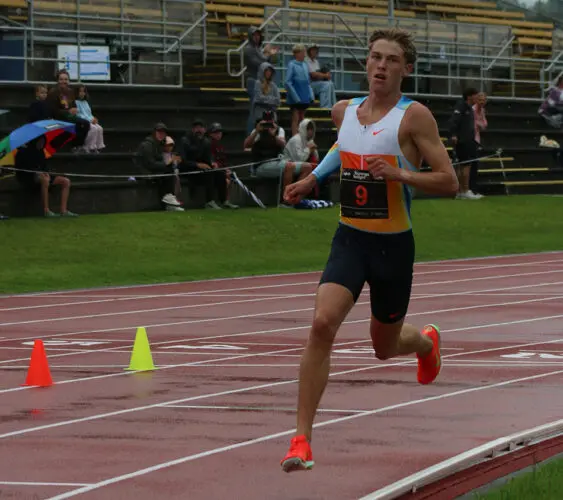
You don’t have to go far to find the post-race analysis. Ben posts cutdowns of the action on Instagram after Sam competes, with the latest mile race footage including a Q&A with Sam’s long-time coach Craig Kirwkood. It is all part of a carefully thought through approach designed to alleviate some of that aforementioned pressure, with the online content helping to feed the growing media appetite for his son’s attention.
“I’ve had to have a crash course in social media,” admits Ben. “The demand for media, especially after his 3:48, went through the roof and so, to some degree, me putting those things on my social media kind of satiates the need for additional media time and requests for Sam. In some ways, it reduces the amount of volume and pressure on him on that front. Part of my job is to try and just make sure that he’s got a well balanced life, which includes plenty of rest and recovery time.”
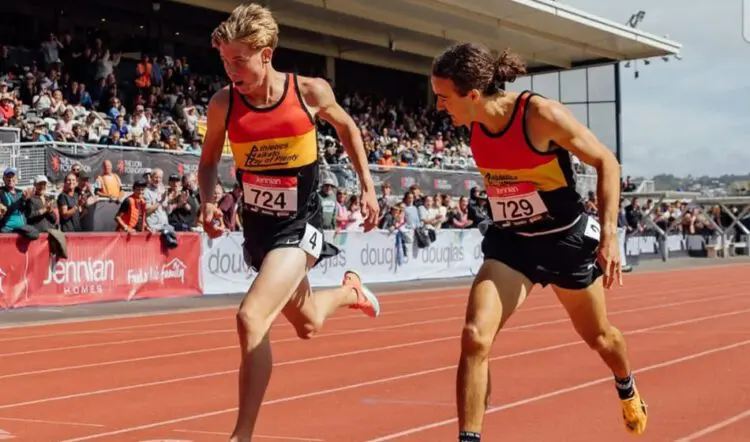
That doesn’t mean he won’t deliberately make life difficult from time to time and there is no better example of this than the race which propelled Sam into the global spotlight.
“When he first ran a sub-four-minute mile, I publicised that he was trying to break it,” Ben says. “I organised the meet, the cameras and the pacemakers. Now that generates quite a bit of media. I didn’t do it because I wanted him to get a lot of media attention and fame from it. I wanted to do it because it was a rare opportunity for him to face pressure, but be surrounded by people that really care for him and look after him.
“I’d rather him face that sort of pressure when he’s got all of the support in the world around him. He’s got a great group of mates that take the mick out of him, which is great for the soul, and they were there that night. When you’re surrounded by people who care, you can learn to deal with pressure much more easily.”
Not only is Sam surrounded by people who care, he is also surrounded by people who have faced the demands of competing at the top level. There is a rich seam of running pedigree to mine from in his family that crosses more than one generation. Sam’s mother Jessica was a five-time national champion on the track, as well as representing New Zealand at four World Athletics Cross Country Championships.
Added to that, her parents were Trevor Wright and Rosemary Stirling. A podium-finisher at the inaugural London Marathon in 1981 and 1978 New York City Marathon, Wright had a best of 2:12:29 from 1983. In 1971 he also ran 2:14:01 to win silver at the European Athletics Championships in Helsinki. Stirling, who met Wright during those championships, won the Commonwealth 800m gold medal at the 1970 Games in Edinburgh and claimed a European outdoor 800m bronze medal, as well as 400m and 800m bronze indoors.
Sam’s younger sister Daisy also runs and, aged 14, recently won the 3000m at the New Zealand under-20 Championships, going one better than her brother’s first attempt. “She’s always having cracks at me, saying ‘oh, did you win?’ and ‘I won this race when you came second’,” Sam says. “She’d do anything she could just to be a little bit better than me and to make me know that!”
That healthy sibling rivalry aside, Ruthe didn’t actually realise the extent of his family’s pedigree in the sport until he was 11, but he believes that genetics have been a factor in his success.
“I feel like that has definitely played a big role in how good I am as a runner,” he says. “Going through primary school and intermediate athletics, when I was doing no training, I did feel like I was quite gifted at running and I’d like to say that it’s mostly down to just the genetics from such a long stream of runners coming down through the family.”
However, Ben feels it is only one ingredient to a much larger recipe.
“Clearly, he’s genetically had an advantage,” he says. “Sam was just amazing to watch at school. He ran in a way that other kids just didn’t run. But I think there are so many ingredients that get overlooked. Jess is incredible at providing great, fantastic, healthy meals. The kids have always really been good at going to sleep. We didn’t let them train at all until they were 13.
“Then you get a coach that really understands how to nurture and develop young athletes, not training them like adults. They’re doing core and strength work, but not lifting any weights at all. So there’s just so many factors that just add up to being able to capitalise on talent. You have to start with focus and effort and then go from there. There are a lot of pieces to the puzzle.”
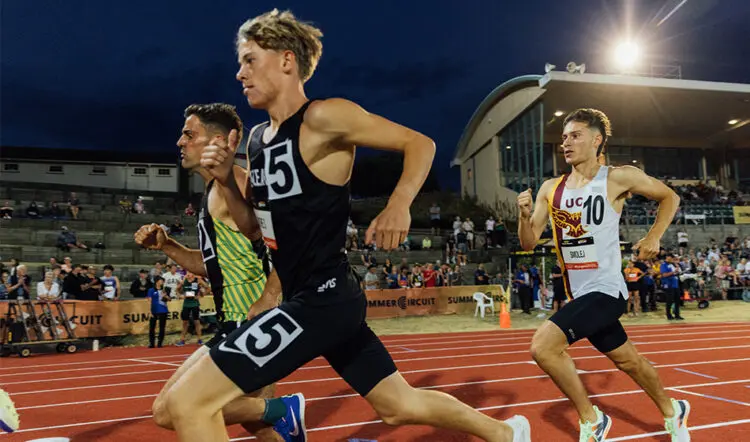
Growing up in Tauranga, located in the Bay of Plenty Region on New Zealand’s North Island, Ruthe was accustomed to the outdoors. He played rugby for six years – Ben jokes he was “atrocious” at it – and had swimming lessons until he was 14.
“Sam was actually quite little when he was swimming,” Ben says. “Some of those 12-year-olds are six foot and he was not. There were times where he’d get absolutely smashed at swimming, but he loved it and it taught him to be really coachable and follow advice. It was also low impact. You can do a lot of it without stress in the body. So it became an easier transition to running, which he also loved.”
Under the guidance of Kirkwood, who has coached Hayden Wilde to an Olympic individual triathlon silver and bronze medal, Ruthe has flourished. His weekly mileage is currently limited to 90km and he does three sessions a week, two on the track and one on the road.
“It’s all pretty light on my body, to be honest,” says Sam, who points out that he uploads every one of his training runs on Strava. “If I didn’t have Craig as a coach, I’d be absolutely useless. If I was in charge of my own running, I’d be burnt out by now and I’d have no speed in the legs. Craig’s a great guy, he’s had so many athletes under his roster and he’s been doing it for a long time. I wouldn’t be here without him.”
“I think people will be a bit shocked at how little [Sam] trains,” adds Ben. “At the same age, Jakob was famously doing 140km a week or something and he’d been training in large kilometres from the age of 11 or 12, whereas Sam did no training until he was almost 14. At the moment, Daisy is doing 30km a week as an example and that’s what Sam started off on.”
Upon his return to New Zealand, Ruthe will start his next academic year. With two years left at school – he is currently studying physics, calculus, geography, economics, English and biology – the academic side of life will soon take over quickly. Sport won’t be too far away, though. Towards the end of this month, he will compete at New Zealand’s Secondary School Triathlon Championships, off the back of no swimming training in the last two years.
“It’s basically a bit of fun and a challenge,” he says. “When I was swimming growing up I was doing it 12 times a week and, you know, the results just weren’t paying off. That’s when I made the switch to running. So I’ll be swimming 750m in Mount Maunganui, which is where I’m from. There’ll be waves. I might end up drowning, but I’ll be having fun!”
And it’s that sentiment that represents Ben and Jessica’s key message to their children –
to enjoy their sport. There are no photos of running in the house, no medals on display and no indication of the generational success in the family.
“Jess doesn’t like us talking about athletics at the dinner table,” Ben says. “I think that kids learn more from seeing what their parents do rather than their parents telling them what they should do. Sam’s just a 16 year old kid, right? He’s still finding his feet and eventually, as he has done with running, he’ll find a few favoured distances in athletics as well. He’s never gone to altitude – and my wife was a really strong responder to altitude training – and he hasn’t lifted weights yet.”
He adds: “He’s running with the handbrake on, because he’s competing in the wrong season, basically. For each northern hemisphere summer, he’s obviously in the southern hemisphere winter, and he’s in the middle of the school year, so to minimise the amount of time away from school, he’s got a really small build-up for the track season. [That means he’s] racing seasoned pros who have had a full build-up.
“So he does really well handling that and, even just being at school, he’s got to train early in the mornings or late in the afternoons in the middle of winter. It’s black, it’s dark, it’s cold and nobody else in New Zealand is doing that work. There’s just a lot of those untapped areas for future gains, which is important.”
All of that does beg the question about how far Sam can go and the summer will see him stepping up another level again. Having signed up for this year’s Bowerman Mile at the Prefontaine Classic in July, the summer plotting has already begun.
Another Diamond League appearance is likely and there is also a possibility that he could compete for New Zealand in the mile – an event returning to the Commonwealth Games for the first time since 1966 – in Glasgow. It could be the start of many major championships for the teenager.
Nothing will be rushed, though, and this American trip has been invaluable to Sam’s development, both in terms of life skills but also as a reference to where he stands in the grand sporting scheme of things.
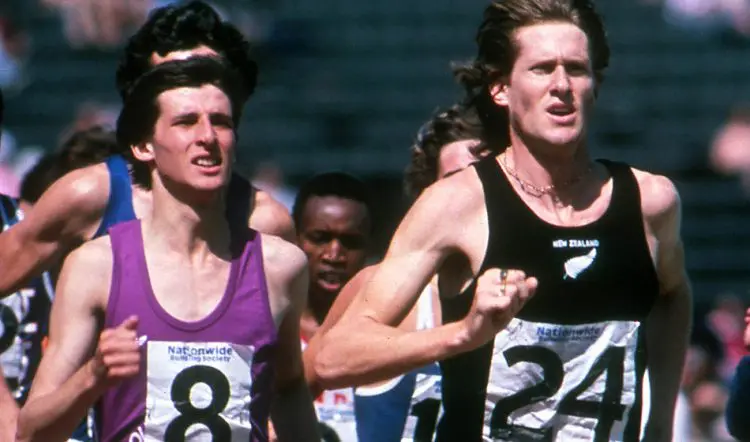
“I’ve been asked a few times around pressure and travelling internationally when he’s only 16, and he’s being put in these big races and all that sort of thing,” says Ben. “But I think any athlete on the planet either wants to run faster times or they want to race better people and try and win those races and it’s just unfortunate for Sam that he can’t do those two things in New Zealand.
“For his 3:48 mile, nobody has run within two seconds of that time in New Zealand in history. As a parent, my choices are, do I keep him in New Zealand running on his own, which I think would make him burn out, because what excitement is there in that? Or do I give him the opportunity to try and run faster against people that are a little bit better than him?
“I think that’s the thing he loves – just giving him the opportunity. And taking away the pressure. It’s not a case of: ‘You need to have the race of your life’ [it’s rather] ‘You’re going to learn a ton from this race. The point of this is for you to learn’.
“Cole Hocker ran away and won by five seconds, which is unbelievable. But how good that he gets to get well beaten, and can look ahead and go: ‘Man, I’ve got some work to do’. He just wants to find those people that challenge him.
He adds: “The process is the enjoyable bit. I’ve had good chats with Daisy as well about: ‘There are going to be hard times. You’re going to have bad years. You’re probably going to plateau for two years at some point, like pretty much all athletes do’. I’ve also talked to Sam around if he gets injured, then he’s going to be the best injured person he can be. He’s going to excel at being injured.”
All of it will be done, though, from a healthy overarching philosophy.
“It’s the enjoyment of the challenge,” says Ben. “And I think if the enjoyment is in the challenge, then it’s a lot easier to go far, whereas if the enjoyment is in the winning, then it’s easy to be disheartened. Sam’s handled everything so well so far and I’m proud of him. I’m just looking forward to a couple of years when he can take the handbrake off.”
Sam Ruthe’s personal bests
800m – 1:45.86; 1000m – 2:17.82; 1500m – 3:33.25; Mile – 3:48.88 (NZ Mile Record); 3000m – 7:43.16; 5000m – 13:40.48
Youth club – six other emerging talents to watch this year
Gout Gout AUS
The 18-year-old sprinter began 2026 with a bang with his first race of the year in Brisbane, running the equal-fastest legal 100m run by an Australian on home soil, notching 10.00 (+0.9). His time matched that of Lachlan Kennedy, who achieved the feat in Perth in April 2025. Gout also set an Australian under-20 record, eclipsing the 10.15 set by Jake Doran in 2018. The national 200m record-holder is due to focus on the longer event at the World U20 Championships this summer.

Cameron Myers AUS
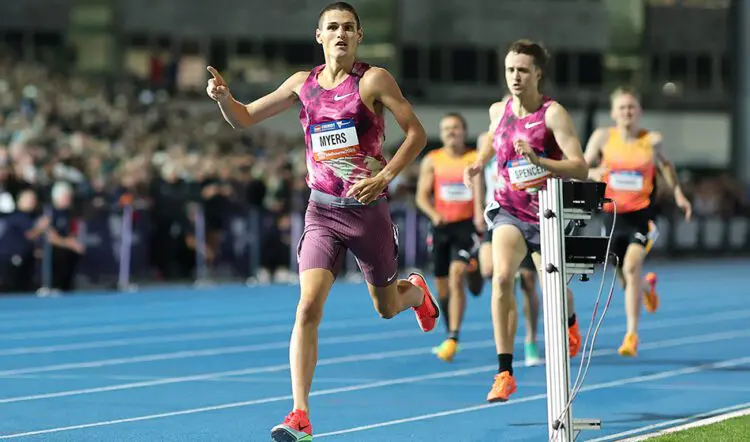
Another young Australian to begin the year strongly, the 19-year-old clocked 3:49.81 in Seattle in January to record the fastest indoor mile ever run in the month of January. He also won the 3000m at the New Balance Indoor Grand Prix and the Wannamaker Mile at the Millrose Games.
Kelly Doualla ITA
At the age of 15, the Italian flew to the European U20 100m title last year. Now 16, the European U18 record-holder will look to test herself on the global stage in the coming year and has already picked up the Italian U18 60m title.

Cooper Lutkenhaus USA
At 16, he became the youngest American ever to compete at the World Championships last summer, having finished second at the US Trials in an U18 800m world best of 1:42.27. He set an indoor U20 world record of 1:44.03 last month.

Marta Alemayo ETH
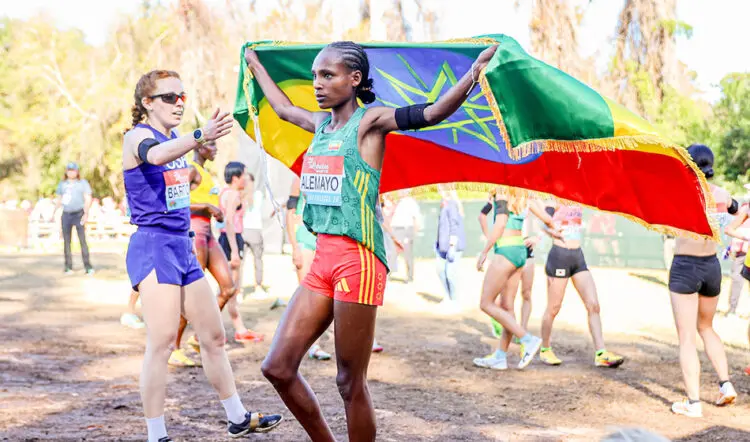
The 17-year-old won her second consecutive women’s U20 title at the World Cross Country Championships in January. On the track, last year she set world U18 bests over 3000m, 5000m, and 3000m indoors.
Innes FitzGerald GBR
The 19-year-old European U20 3000m and 5000m champion also holds the continental records for those distances and won her third consecutive U20 title at December’s European Cross Country Championships.


