



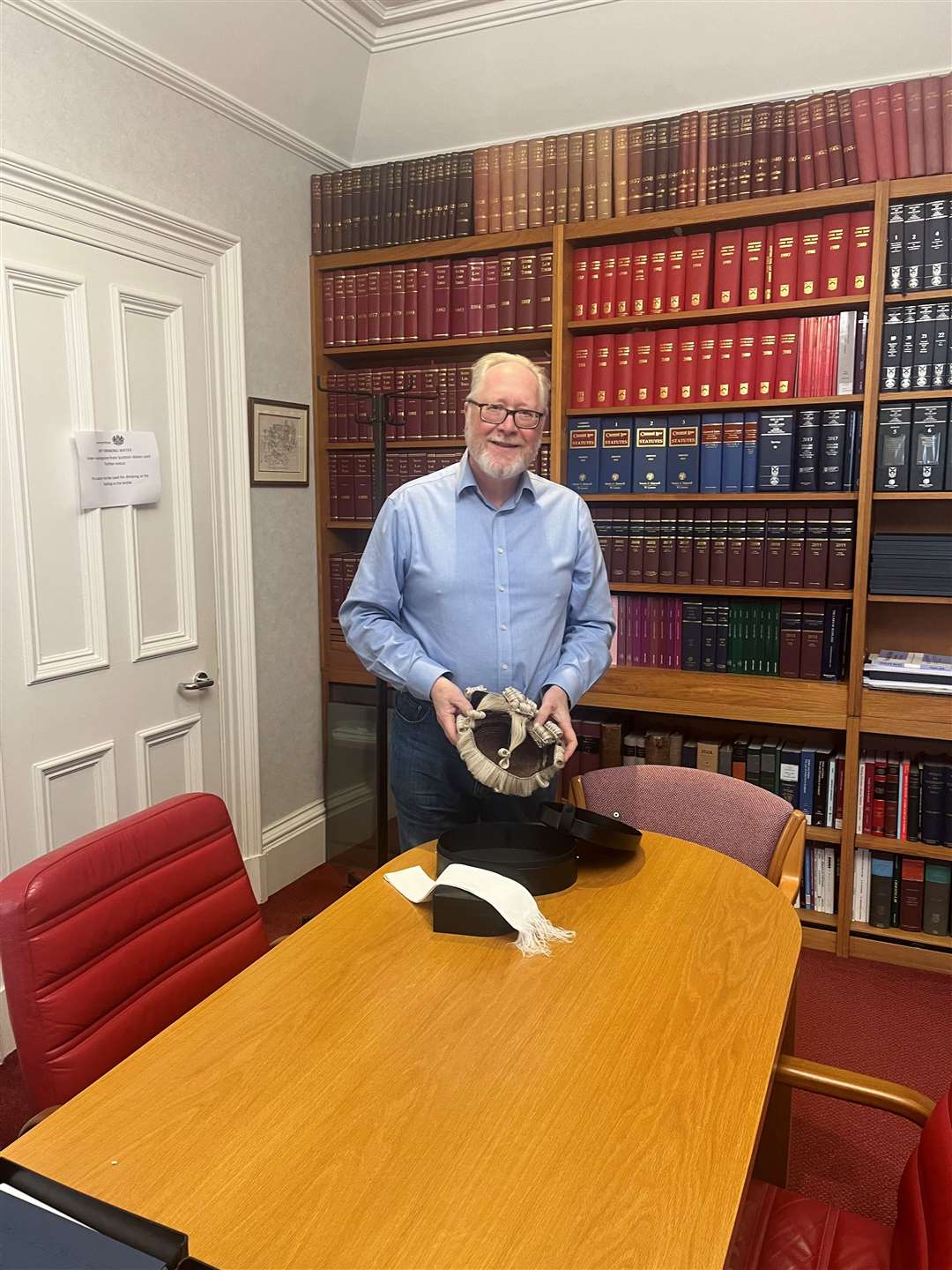


When Sheriff Ian Cruickshank first came to Shetland to take up judicial duties he knew more about the isles’ musical heritage than its legal landscape.
Now, eight years later, as he packs up his sheriff’s wig and bids farewell to Lerwick Sheriff Court, the keen accordionist is more in awe of the traditional music scene than ever before.
He also hopes to have established a reputation as a “firm but fair” sheriff who has taken a pragmatic approach to the administration of justice in the community.
“In a professional capacity, it’s been very rewarding indeed,” he told The Shetland Times on Friday. “I’ve never been disappointed in taking up this role. It’s a constant challenge, with varied work to be dealt with every day.
“But it’s been a great first posting – the fact that you are the only sheriff means you make all the decisions. And I think that stands me in very good stead to go to any court anywhere.”
Prior to taking the role, Sheriff Cruickshank had been a solicitor at private practices, including his own in Elgin, which he led for 20 years. He also sat on the Law Society Council for a number of years, taking up the role of convener of the criminal law committee. In that capacity he was involved with Lord Bonomy’s review into post-corroboration safeguards as well as Lord Bracadale’s hate crime review.
Then, when the judicial appointment board for Scotland announced it was looking for a sheriff to fill the post, Sheriff Cuickshank leapt at the chance.
“I had wanted to be a sheriff for quite a number of years, and so when the Lerwick post arose, I thought ‘I’ll give that a bash’ and here we are years later,” he said.
“I felt it was a natural progression because, having been a solicitor and a solicitor advocate, doing a lot of criminal and civil work in Sheriff courts, I wanted to go from presenting the case to deciding it.”
Throughout almost eight years in post Sheriff Cruickshank has led the court through some tricky times, not least when Covid-19 forced it to close to the public for a number of months.
Even when it reopened, the way court business was conducted had changed considerably.
“Everything now is done remotely,” he said.
“I sit in chambers looking at a screen and speaking to people, and that’s a big change.
“In some respects, it’s better. It must help solicitors who otherwise would have to come a long way to get here and sit for hours, not able to do very much.
“But it’s also got its limitations, and you’re always dependent on the technology working, which it’s not always done.”
As well as frustrations with technology, the sheriff has had to contend with transport issues preventing defence agents making it to Shetland for their hearings.
“It may have been a frustration in the early years, but I started to understand the vagaries of the weather in Shetland,” he added.
“It’s something you have to accept. You have to find methods to work around it as best as possible.
“And hopefully that’s what we’ve done.”
“I may, from time to time, have shown irritation, but hopefully it wasn’t full blown anger, as I appreciate it’s nobody’s fault and people are doing their best to get around it.”
Although Lerwick Sheriff Court has fewer cases than most, Sheriff Cruickshank said it still faced the “entire plethora” of business encountered anywhere else.
The court has seen some unusual legal arguments presented, not least by sovereignty campaigner and udal law proponent Stuart Hill, whose latest trial last Thursday was the sheriff’s final business in the court.
When asked about particular cases, however, the sheriff diplomatically opted not to delve into specifics.
“There are obviously many cases where you have to make a difficult decision, and you’ve got to appreciate that the public might not agree with you,” he said.
“But at the end of the day, you’re the one that’s got to make that decision.
“And what I hope I have done is, to be as fair as I can, and take on board everything that I hear and then base the judgment on that having applied the appropriate law.”
While he will be leaving Lerwick, for now, Sheriff Cruickshank is far from done with the profession.
He will remain resident sheriff at Inverness for two weeks in every four, and for the other fortnight he will become a “floating sheriff” visiting courts throughout the Sheriffdom of Grampian, Highland and Islands, which includes Lerwick.
It may not be too long before he is back, as no permanent replacement has yet been announced.
If and when that happens, he said he might bring his accordion for a few tunes at The Lounge, which has been one of the highlights of his time here. Sheriff Cruickshank said the music scene had been one of the “big drivers” which first brought him north.
“I knew the Shetland music scene was very strong – but I didn’t fully appreciate how strong it was,” he said.
“I knew there were excellent players in Shetland, but I never knew there were quite so many.
“There are world class musicians in Shetland, in the Scottish genre and other genres. And you just find them all so open and welcoming.
“It doesn’t matter what your level of ability is, they’re all happy to sit down just for a tune. And that’s what I’ve found to be so good.
“One thing that I don’t think I’ll be doing, when I go back and I’m sitting in Inverness and living in Elgin, I probably won’t be nipping down to the pub on a Wednesday night for a tune.”
Another pastime the sheriff was able to pursue in Shetland was his love of fly fishing. “It’s another great bonus having been here and just the number of trout lochs,” he said.
“I could finish here in the afternoon and, in the season, just look at the weather and think, ‘well, where would I like to go?’
“And it’s just been fantastic. I haven’t really made a great dent in the trout population, but I’ve had a lot of fun.”